Effective leadership is fundamental to building successful Family Hubs. This toolkit explores how collaborative leadership can strengthen partnerships, drive system transformation, and improve outcomes for children and families.
Aim of this resource
Developing an integrated Best Start system and family hub involves sharing leadership, moving away from decisions being made by one organization and merely consulting others. Over the last decade there have been many terms developed to describe this type of leadership including systems leadership, distributed leadership, collective leadership and collaborative leadership. In this module we will use the term collaborative leadership as being able to collaborate – at all levels – is an integral part of transforming our Best Start systems.
With this resource you will be able to:
-
Explore and understand more about the nature of collaborative leadership.
-
Identify and explore the unique set of skills needed to build and lead effective, integrated teams.
-
Reflect on how collaborative your leadership style is and ways to further develop it.
-
Create an action plan for yourself.
Introduction
Collaborative leadership is central to developing an integrated Best Start system and yet there is little acknowledgement of the unique set of behaviours, skills and leadership practices needed. Whilst guidance reflects the need for cross sector partnerships and collaboration, there is almost an expectation that leaders can make the leap from managing in a single agency, often characterized by traditional hierarchical structures, to building collaborative teams without any understanding of the differences and challenges involved. It becomes – for many – an intuitive process with leaders often functioning within both traditional and collaborative leadership arenas at the same time.
In relation to Best Start (family hubs), developing a shared strategy and vision, coordinating integrated operations, managing multi-agency teams and making synergies across different organisations are at the heart of the work, meaning that leaders work with people over whom they don’t have formal authority in the traditional sense. To do this in a way that transforms how the work is delivered and is sustained takes considerable skill but will create life changing new opportunities for children.
Research and evidence
Collaborative leadership supports transformation. It brings together different perspectives to create something new, taking away competitiveness and stereotypes that all too often develop between organisations. At its heart it is relational and inclusive but it takes time to nurture and grow the connections between organisations.
What is collaborative leadership
There are a wide range of resources which describe collaborative leadership across a range of sectors. Here we have collected some of these which we feel provide an overview.
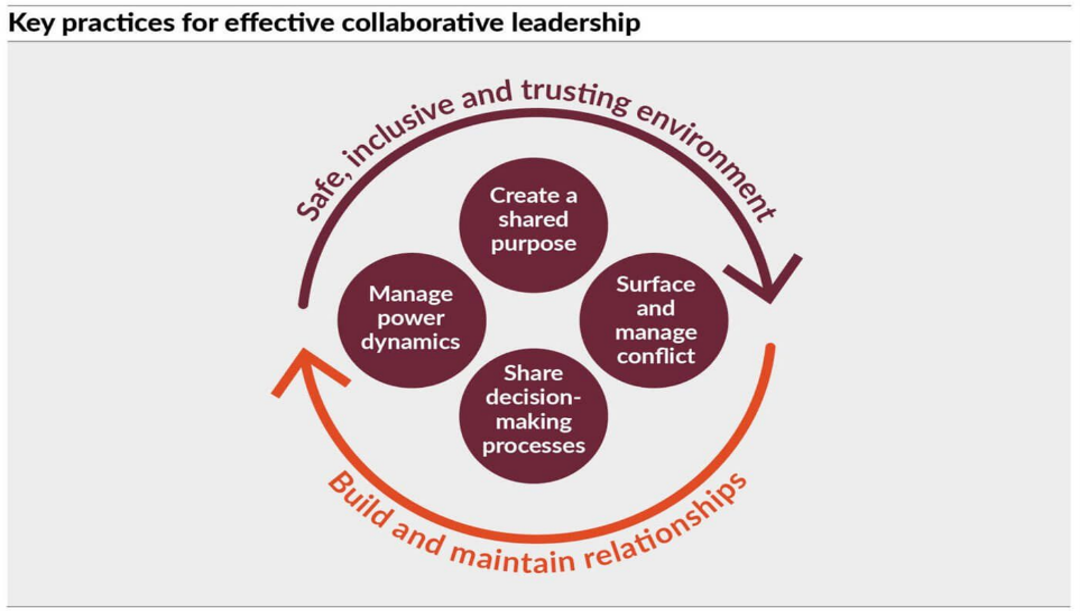
A good starting point is to familiarize oneself with the nature of collaborative leadership and how it differs from traditional, hierarchical leadership styles. Probably the most relatable piece of recent research - as it is linked to health and care- is a report published by the Kings’ Fund in July 2023 entitled: The Practice of Collaborative Leadership by Nicola Walsh and Stephanie de Sarandy. In their report, they state that ‘…collaborative leadership actively promotes the need for leaders to switch from a focus solely on individual sovereignty to one of shared stewardship’. Stating that … ‘in this report, we define a collaborative leader as someone who can create a safe, inclusive and trusting environment in which all can contribute fully and openly to achieving an agreed shared goal’.
Importantly, its authors offer us a model for the practice of collaborative leadership that is applicable to Best Start Family Hubs and is a useful tool for helping us to reflect on the maturity of our Best Start systems. We will refer back to this later in the module.
This model is outlined here:
Figure 1: Key practices for effective collaborative leadership (Nicola Walsh, Stephanie de Sarandy – July 2023)
Other useful articles on collaboratives leadership are:
The Oxford Leadership White Paper on Collaborative Leadership, although written over a decade ago, provides a useful overview of collaborative leadership of particular interest are the practical tips for promoting high-quality collaboration on the diagram that shows that collaborative leadership involves a shift from ego system to ecosystem it also acknowledges that very few senior leaders have been trained to lead collaboratively
Research from Warwick Business School outlines Seven Key Competencies for Collaborative Leadership (2024) essential for navigating digital transformation and fostering innovation.
Compassionate leadership
It is clear that all the research reports on collaborative leadership puts an emphasis on the importance of developing a relational approach and building trust between organisations / team members and for this reason it is worth also looking at Professor Michael West’s work on compassionate leadership. Michael West is professor of organisational psychology at Lancaster University and senior visiting fellow at the Kings Fund. His leadership approach puts emphasis on the importance of compassion and collaboration in health and social care. The use of the word compassion seems very relevant to offering families – and their children - the Best Start in Life. It is a word that is sadly rarely used when talking about service offers or developing a new culture and yet it is an important behaviour that we all welcome in accessing services. Michael West advocates for leaders to embody compassion in their actions and foster cultures of high quality care and innovation.
Here is a good summary of his work on Compassionate Leadership and you can watch: Compassionate and Collaborative Leadership that formed a part of the King’s Fund Leadership conference in 2017.
Michael West’s book entitled, Compassionate Leadership,sustaining wisdom humanity and presence in health and social care (2023) is an interesting read and links compassion and a collaborative approach, particularly in chapter 10.
We will return to Michael West’s work later in this module when we look at the leadership behaviours needed as collaborative leaders.
A quick summary of collaborative leadership
Collaborative leadership is essentially relational and inclusive.
It is about:
-
Influencing versus exerting authority
-
Creating a climate of respect
-
Agreeing the ‘collaborative advantage’ – sharing a vision / purpose
-
Innovating through group solutions, maximizing the use of everyone’s skills to find better solutions for families.
-
More inclusive as it rebalances power.
Some of the challenges of collaborative leadership
The key challenges of developing an integrated system through leading collaborative are:
It takes time: it takes considerable time to transform into an integrated delivery system. Family Hubs Innovation Fund Evaluation (November 2023) emphasized that this transformation can take 3 to 5 years, especially without dedicated funding or extra staff. Even with extra funding, it is important to emphasize that this change is dependent on the skills of the leaders having an understanding of the need to share leadership, agree a shared purpose through time invested in building relationships and trust. If this process in your area has resembled a process of consultation rather than collaborative leadership there is always an opportunity to start the process again through a more integrated approach. On a positive note, the process of building an inclusive, integrated system can start at any time. If you have been focused on meeting deadlines and ‘consulted’ rather than built a culture of shared leadership and collaboration you can start to do this now.
Making decisions and managing conflict: agreeing purpose and sharing leadership requires considerable investment in conversations to achieve consensus. There can be a temptation to ‘stop’ moving forward every time there is a conflict or lack of agreement. The skill is to address conflicts as / when they arise whilst keeping the transformation process nudging forwards. It is a skill to achieve this balance. A clear purpose and shared vision makes this easier.
Transforming the whole system: often the governance arrangements reflect the desired integration, bringing together strategic leaders from across the system but it is vital for this integration, including meeting structures, to be reflected at all levels. If the strategic leaders share a common purpose – say to implement family hubs – but the operational leaders never meet together the system won’t be sustained. Similarly, if organisations don’t change their internal meeting arrangements to reflect being part of an integrated whole, staff and managers will see the Best Start / family hub meetings as additional – taking more of their time – rather than being a new order. This transformation is essential for long-term sustainability and commitment. This article demonstrates how Westminster City Council began their journey from partnerships to integration.
Using the model offered by Nicola Walsh & Stephanie de Sarandy (July 2023) - in Figure 1 above - as a framework from which to measure local progress can be helpful in minimizing challenges.
-
What skills and behaviours do we need to adopt as Collaborative leaders?
Collaborative leadership Is intensely relational. It requires a complex integrated mix of personal, interpersonal and professional skills. It moves beyond traditional command and control approaches to rely on influence, trust, and shared decision making,. Demanding a high level of competency across these various domains.
5.1 Personal skills
These are internal attributes focused on self-awareness and mindset which allow leaders to manage their own behaviour and sense of authority. It is important to develop tools to reflect and develop these attributes. Perhaps the greatest personal skill is that of self-awareness and humility and the ability to mentalize.
Self-awareness: a useful tool for developing greater self-awareness is to use the Window of Tolerance a concept developed by Dan Siegel, which describes the optimal zone of emotional and psychological arousal. In leadership the window of tolerance describes where a leader can function well and make good decisions whilst maintaining emotional regulation. When leaders operate outside this window, they may experience numbness, an inability to act or hyper / hypo arousal (anxiety, agitation, fight or flight). Recognising these states is vital as a collaborative leader and to try to use tools like mindfulness or supervision to widen one's window of tolerance and the ability to be self-aware enables transformation to keep moving forward.
Mentalizing: this was conceptualised by Peter Fonagy and others at Anna Freud. It is the ability to make sense of the behaviour of self and others. It is critical for emotional regulation and the ability to mentalize can prevent the stereotypical views we often hold of other organisations. Instead it provides us with the opportunity to understand why a particular organisation reacts as it does. Watch: What is Mentalizing
Daniel Kahneman in his book, Thinking Fast and Slow (2011) conceptualised a critical tool that can be helpful for mentalizing i.e. understanding and evaluating ourselves and others. He differentiates between two modes of thought which he calls system one, which is fast- automatic - and system 2, which is slower and deliberate thinking. This is a useful tool for leaders as it helps leaders to recognise when to trust instinct i.e system 1 and when to slow down for analytical reasoning, leaders can better navigate interpersonal dynamics reduce bias and make more emphatic effective decisions. There is a good description of system 1 and 2 here .
This article explains it further: Why Great Leaders Mentalize, and 5 Exercises to Help You
Compassion: Compassion is a crucial personal leadership skill. It builds deep trust, psychological safety and loyalty. By understanding and validating team members needs leaders can boost morale, reduce burn out and foster a collaborative working environment where all feel valued. At its heart compassion is inclusive.
Self-compassion is also vital for successful leaders. It means being understanding towards ourselves in difficult situations and recognizing that things cannot be perfect all the time. As Professor Michael West who we referenced above writes in his book on Compassionate Leadership (2021) “Self-compassion helps us take a balanced approach to negative emotions so that feelings are both accepted and regulated. This requires us to observe our feelings and thoughts, openly and clearly, and (ideally) in a non-judgmental way”.
5.2 Interpersonal skills
These skills are crucial for building the relationships and trust needed to make collaboration work.
-
Trust building & connecting people: Creating a secure environment where team members from within one's own organisation and others feel safe to share ideas and take risks
-
Motivating others: Ability to motivate others and encourage them to work towards a common goal. Identifying the unique strengths of team members and empowering them to own tasks
-
Active listening: Professor Michael West talks about listening to understand rather than to respond, to ensure all voices are heard and refers a lot to ‘listening with fascination’ a term originally associated with Nancy Kline, the author of ‘Time to Think’. She emphasizes the importance of respectful listening in leadership and personal development. Kline’s model of Attention, Interest and Fascination are essential for effective communication and understanding. which are essential for effective communication and listening. You can listen to more about her work here
-
Conflict resolution: Productively managing disagreements to find solutions that support the collective rather than suppressing dissent.
5.3 Professional skills
These skills relate to technical and strategic aspects of leading the work.
-
Strategic vision: aligning goals from a variety of organisations and building a shared purpose.
-
Facilitation: Facilitation skills enable leaders to make the shift from directive leadership to bringing different groups and organisations together, ensuring greater equity and psychological safety.
-
Focus on outcomes: to have clarity about the outcomes that everyone wants to achieve and to keep a focus on this through the use of data and digital tools.
-
Linking commissioning: collaborative leadership requires commissioning to change from a traditional transactional procurement model and become an integral part of the collaborative transformation. You can read more about this in a paper written by the Kings Fund here.
-
Understanding your stakeholder relationships: Engaging the right stakeholders at the right time during the lifecycle of your BSIL programme can make a big difference. Making relationships and communicating with stakeholders effectively will help to ensure BSIL objectives are met and are received positively. You can read more here and use this tool to develop your local picture
https://analysisfunction.civilservice.gov.uk/policy-store/stakeholder-mapping/
-
Understanding how you react to and approach managing change: When we engage others in transformation and change it is useful to reflect on how we experience and respond to change. You can use tools to explore this for yourself and with partners to anticipate responses and mitigate those which may slow or derail plans. An example is in section 6 Top Tips.
Dr. Elisabeth Kübler-Ross, a Swiss American Psychiatrist, introduced the five stages of grief—denial, anger, bargaining, depression, and acceptance—in her book On Death and Dying (1969). You can read more here:https://www.ekrfoundation.org/5-stages-of-grief/change-curve/. Since then, the stages have been adapted into leadership and organizational contexts as the Kübler-Ross Change Curve® to help leaders and managers support teams through restructuring or transformation. The change process itself is best understood as fluid and nonlinear. People often revisit earlier responses as circumstances evolve, reflecting the dynamic and ongoing nature of adjustment. The change curve offers a framework for understanding common emotional responses to significant transitions.
John Kotter’s Change Model provides us with some tools to anticipate and mitigate some of these stages and responses to change. You can read more here: Kotter's 8 steps of change.pdf. The key ideas are: creating a climate of change, engaging and enabling the whole organisation (partnership) and implementing and sustaining change.
-
Belbin team roles: Dr Meredith Belbin’s Team Role Model identifies nine behavioural patterns that describe how individuals interact, contribute and work together in a group. In a similar way to having different reactions and responses to change, many of us have developed and/or have innate preferences which manifest in our thinking and working styles, particularly working in teams. It can be useful for your strategic board or integrated delivery teams to explore each other's diverse styles and think how they can work to their strengths as a group or bring in others to with missing skills/styles. You can read more here: https://www.belbin.com/about/belbin-team-roles
This mix of personal, interpersonal and professional skills and knowledge is vital as a collaborative leader because one needs to move beyond positional power to influence, inspire and build high-quality lateral cooperation with peers and teams from other organisations often without direct formal authority. Achieving this creates a collective intelligence that can outperform individual talent enhancing innovation and adaptability.
Practical steps for developing a culture of collaboration:
Governance arrangements and sharing power: Who chairs the Board? Is it the Local Authority? Could this be shared with another organization? With health or a key voluntary sector partner. This will be different depending on the local context but is a very visible sign of collaboration. There are good examples of this working across the country.
Meeting structures: have you changed and integrated meeting structures at every level? Strategic, operational and practitioner. Have you ensured that this has transformed meetings rather than adding more for everyone. In effect, has your new system reviewed all meetings?
Outcome focused agendas: Have you adopted a shared outcomes framework? This supports the planning of agendas with outcomes in mind, pre-briefing chairs for desired outcomes for each agenda item, ensuring you have local evidence, particularly service user’s insights or customer journeys for the board, or other meetings, to focus on outcomes for individual children.
You can read more about developing an outcomes framework here: Common Outcomes for Children and Young People Collaborative
Allocating time to revisit the common purpose: often there is considerable time spent on developing a shared vision at the start but it is equally important to revisit this together – and grow it – at least twice a year. This should be done at every level within the system. Especially as people leave and join organisations.
Action Learning Sets: Could you consider running a local Action Learning Set on collaborative leadership for your operational managers. Material in this resource could be used to bring managers together from different organizations to develop a shared understanding of collaborative leadership.
Remember the workforce: the workforce are the backbone of any new integrated system and if the work is to be sustained a multi-agency workforce strategy and training programme is vital. Is there a common approach to the delivery of practice that brings all organisations together? Any integrated workforce training should include a shared induction programme as developed in Merton Council.
There are a number of examples where this has been used effectively to ensure the whole workforce shares the same values, knowledge and priorities in implementing complex multi-agency delivery. Making Every Contact Count is a well-established NHS method and training programmed which may be a useful approach to build on locally when you work to ensure all practitioners in your BSIL system are focused on identification of need and how to use relationships to engage families into a system of support. https://www.meccgateway.co.uk/nenc/training. You may wish to consider a joint training programme for your integrated delivery team managers to move the Board’s strategic vision into practice. Examples of these can be found in the Westminster and Croydon case studies at the end of this Toolkit.
Understanding your reactions to change: this exercise was developed by Interface Ltd.