Understand how the opportunities are going to be delivered; how might you make the whole thing work financially; and who else needs to be involved including potential partnerships both internally and externally.
Overview
- How are the opportunities going to be delivered?
- How might you make the whole thing work financially?
- Who else needs to be involved, including potential partnerships both internally and externally?
- What are the risks to delivery, such as changes to funding criteria or budget reductions, political priorities changing, new policy and legislation?
- What are the funding needs, pressures and costs of doing nothing?
- What are the challenges, opportunities and risks for your authority?
- What are the delivery models being used by local authorities?
- What are the most common forms of funding and finance used by local authorities?
What are the funding needs, pressures and costs of doing nothing?
The need for urgent action
Over the last few years around 75 per cent of councils have declared a climate emergency, with many of these also declaring an ecological emergency. Meeting these commitments will require significant investment into low-carbon and resilient infrastructure.
-
urgent action is required to deal with increasing risks from climate change
-
safeguarding and strengthening nature is key to securing a liveable future
-
there is a narrowing window for action
-
cities: hotspots of impacts and risks, but also a crucial part of the solution.
Level of funding required
What is the level of funding required to bring about change and meet government targets? Green finance gap, public funding into nature and the need for private investment?
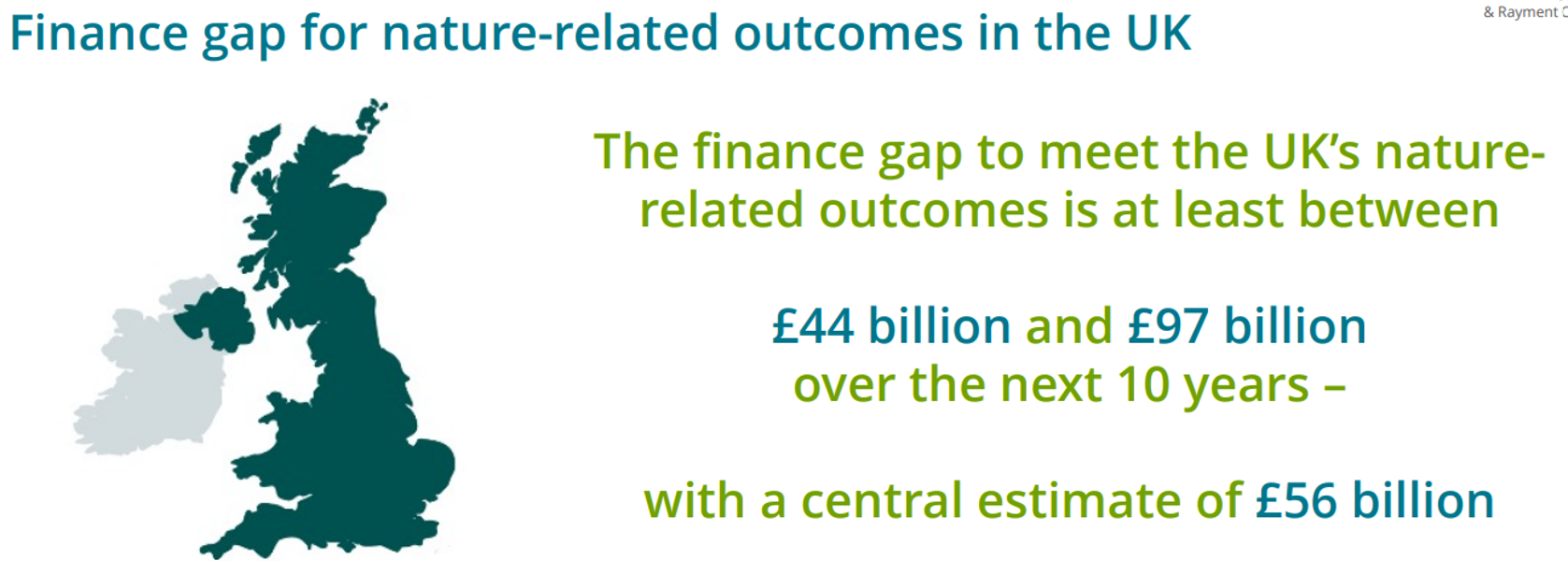
The Green Finance Institute and others estimate that the finance gap for nature is between £44 to 97 billion over the next ten years with a central estimate of £5.6 billion per year. Specifically, there is a £354 million finance gap in the UK for natural flood management. The finance gap is the difference between the amount of spending that is currently planned or committed, and the amount that is required.
Current environmental funding sources, mostly public and philanthropic grants, are unable to meet the need to prevent further decline of the natural environment. Such grant support will remain critical if we are to reverse the current crisis, but a significant increase in funding is needed to support the recovery of the natural world. The reform of public policy and an appropriate regulatory framework will also be crucial for both protection and restoration.
Level of funding required
- Public and philanthropic capital is insufficient alone to meet the funding needed to protect GM’s natural environment.
- Public funds that are available are segregated and managed independently preventing strategic allocation for target projects.
- Nature-Based Solutions (NBS) such as ecological restoration and urban green infrastructure draw upon limited funding resources.
- NBS project developers tend to suffer from a lack of:
- viable business models to access private investment
- project scale and aggregation opportunities
- arrangements for accountability and governance
- detailed understanding of the value of NBS benefits and
- capacity to innovate and develop new funding opportunities.
- There is an urgent need to attract new sources of funding such as impact investment to protect the city region’s natural environment, and to deploy existing sources more strategically.
For more information check the funding gap for natural capital projects in Greater Manchester.
Public funding into nature
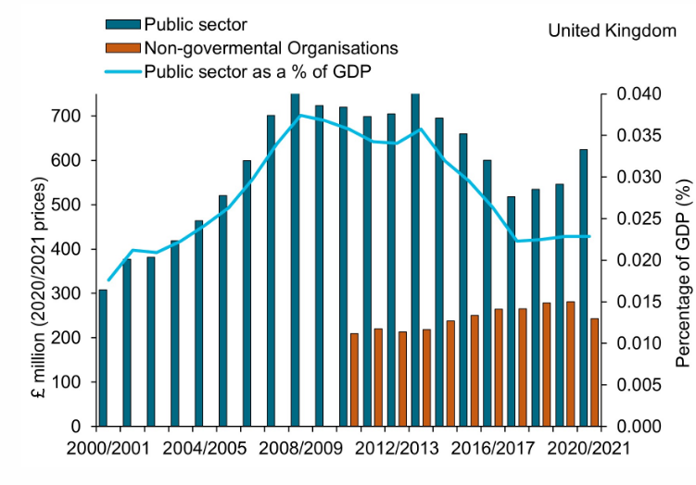
There is a limited amount of public sector finance available which has been declining in real terms over the last decade.
Declining from an all-time high of around £700 million in 2013/14 before falling in real terms. So other sources of funding, non-public, non-grant funding are needed to meet our aims. That points to private investment.
The Governments approach to Green Finance
Developing a project pipeline
What local authorities need first is a pipeline of projects with a degree of deliverability (commitment to project delivery, timescales and ready to do) that meet funding criteria.
How do you fund the development of projects including the business case? These plans need revenue and time required to put together funding applications and project pipelines as well as appetite for take up and risks.
Key findings from the PAS Nature Recovery Emerging Insights report (2022) include:
-
Staff, capacity, funding and recruitment all remain big issues for local authorities and a key barrier to the delivery of nature recovery activities.
-
Putting together a pipeline of nature recovery projects takes time and resources to pull together and deliver on the ground.
-
Some local authorities have been successful in securing seed and revenue funding such as Defra’s Natural Environment Investment Readiness Fund (NEIRF) which provided much needed capacity and resourcing to get project proposals off the ground. The Green Finance Institutes HIVE includes a range of resources and case studies on how the seed funding has been used to develop investable projects.
-
Whilst funding opportunities exist resource constraints and council processes have meant that not all councils been able to develop a set of robust proposals which meet specific funder requirements and short timescales for submission.
-
In some instances capital has been available for habitat creation but not the resources for maintenance. Issues have been identified around supporting sites in private ownership, creating new infrastructure and greening previously grey areas at scale.
Essex County Council has invested in the coordination and leadership of partnerships to deliver green infrastructure, shared outcomes, and funding opportunities. Recruitment of new environmental officers led to leveraging in additional resourcing and considerations on how this can create sustainable funding opportunities for new nature recovery projects.
Why not run an internal workshop to develop a pipeline - resources can be found in Delivering the Toolkit
Linking interventions, grant funding, revenue and investment
How can different pots of funding and finance be blended together to deliver wider benefits?
Blended finance refers broadly to the complementary use of grants (or grant-equivalent instruments) and non-grant financing from private and/or public sources to provide financing on terms that would make projects financially viable and/or financially sustainable. Defra are moving more towards blended as pressures on public monies increase.
Some local authorities are further ahead than others in their thinking about how different funding streams and financial models fit together. Some are pooling new burdens funding whilst others are encouraging blended finance at a senior level and building into their business cases such as highways funding.
Uncertainties in the market caused by rescheduling of new funding streams such as environmental land management schemes have made it difficult to engage with investors, buyers and suppliers and bring nature recovery projects forward.
Why is it challenging engaging with private investors & buyers?
-
Improved financial viability and gaining access to private sector finance by mitigating risks and/or increasing private returns, blended finance can enable projects to access private sector finance and thus beneficiaries can gain access to funds from the private sector that would not be available under ‘normal’ market conditions. This is particularly relevant for projects that fail to attract sufficient resources traditionally.
-
Given the large infrastructure financing gap and the significant pressure on government budgets, the financial additionally provided by blending potentially plays an important role in increasing the net impact of donor funding, as every unit of donor money attracts non-grant funds which are several times higher than the original donor investment.
-
Positive demonstration effects. Blending can create positive demonstration effects, for example, the project leads other market participants to change their behaviour
-
Improved financial sustainability of projects Blending can improve financial sustainability over pure grants
-
Promote cooperation and coordination among donors. Blending can improve the quality of interventions as many blended finance projects involve more than one donor. This can result in a sharing of expertise, skills, practices and lessons learnt.
Greater Manchester Combined Authority's case study showcases how innovative funding models are being developed blending both private and public sector funding opportunities.
- Working in partnerships pooling resources enables schemes to go ahead that are not affordable for the individual partners on their own.
- No single body has sufficient funds available to meet the threshold cost by themselves.
- Pooling resources, not only meets the threshold cost, but have sufficient funds available to achieve wider aspirations and deliver multiple benefits.
- Sharing risks reduces individual organisations’ exposure to risk.
- Reduces duplication of effort and introduces efficiencies of scale that reduce costs and provide savings to the contributing partners.
- Improves the viability of the project.
Multiple benefits, outcomes and measurables
A need to be clear about direct and indirect benefits
- A key feature of green finance is the need to be able to verify that the project has produced the environmental benefits set out in its original business case.
- The measurement and verification process can take a number of forms, but all should be clear, transparent and auditable.
- For some schemes there are national or international accreditations that into mainstream financial decision making.
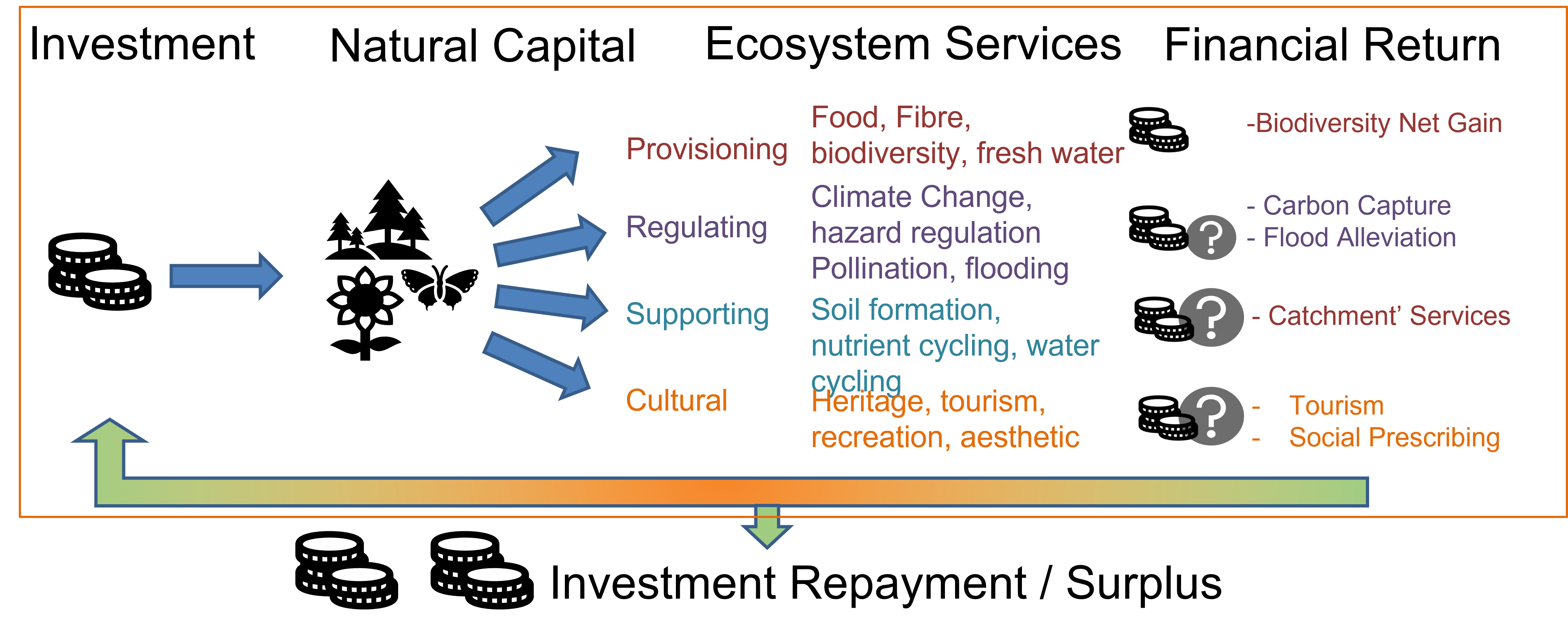
- Multiple benefits which link to outcomes and measures that meet different policy requirements such as Environment Act, Environmental Improvement Plan and Sustainable Development Goals. It needs to be tangible.
SOURCE: Warwickshire County Council
Growing private investment needs the development of markets
If we think about carbon offsetting as an example, to have a functioning UK carbon offsetting market we’d need:
- Demand for carbon offsets – we have some voluntary demand developing but no legal obligations yet.
- Data about the carbon stored in different projects – this is developing but nature isn’t standard and performs differently in different circumstances.
- Local delivery – integrating different sources of funding, ensuring projects are delivered, developing confidence.
This is complicated and developing slowly and at different speeds for different services that nature provides.
Unlock capital through green finance and supporting the development of a local market. Local authority examples include:
- Greater Manchester Natural Capital Investment Strategy
- Green investment for Greater Lincs
- Investing in Climate and Nature, South Gloucestershire Council
Green finance refers to a wide range of bonds, loans and funds that can be used to channel investments towards environmentally positive outcomes. This area of environmental economics is rapidly innovating and LAs could utilise a growing number of these approaches to drive investment in NBS.
The Greater Manchester Natural Capital Investment Plan was established following the Mayor’s Green Summit in 2018, to mobilise existing and establish innovative sources of funding for nature. The plan aims to enhance the opportunities for investment in natural capital, acknowledging the complexities in delivering an attractive return to the investor, whilst ensuring wider benefits in the long-term. The plan has three key stages:
- Identify a pipeline of potential project types which need investment.
- Develop finance models to facilitate private sector investment without further burdening the public sector.
- Produce recommendations to put the plan into practice over the next 5 years.
Risk and finance
| Concept and feasibility |
|
| Procurement and construction |
|
| Steady State Operation |
|
Key considerations
-
Can the project demonstrate it primarily supports the function of the local authority?
-
How will the project’s sustainable benefits be measured and verified?
-
Is there a source of grant funding available for the project? It should be noted that these change from time to time, so it is important to keep up to date.
-
Recent grant may be repeated in subsequent years. In order to access funds, it may be necessary to move quickly, so preparing schemes in advance is an advantage when looking to secure grants, if grants are not available this will also assist in seeking alternative means of funding.
-
Access to alternative routes for funding have an administrative burden (for example enhanced levels of project specific due diligence) which need to be considered as part of the funding decision.
-
Councils have access to both grant funding and cheap finance, providing a competitive advantage over the private sector where there is competition for assets.
-
Where councils are offering finance into joint venture projects or to utilise their land assets to leverage projects the implications of state aid and more complex procurement need to be fully factored in alongside the potential benefits of new sources of capital and expertise.
Key questions to address:
-
What are the types of savings, funding and finance sources already being secured by your council and can these be replicated across other departments?
-
What are the models of delivery that are already being delivered by your council and can these be replicated across other departments?
-
What are the partnerships already in place that can support delivery and is there an opportunity to build on these or form new ones?
Further support and guidance
- LCRCA Policy documents including funding
- Sweep report on Alternative Funding Mechanisms for Green Space
- Sources of funding - APSE energy funding opportunities monthly newsletter
- ADEPT Green Finance Toolkit for Place Leaders
- LGA financing green ambitions
- IGNITION
- GM Environment Fund Investment Strategy
- Surrey County Council Green and Blue Infrastructure webpages
- GFI Investment Readiness Toolkit
- Catchment Based Approach – Developing Investable Projects Guidance
- Ecosystem Knowledge Network.