Volunteers play a vital role in the success of Family Hubs, bringing skills, lived experience, and community insight that enrich the support offered to children, young people, and families. This toolkit has been designed to help Family Hub teams confidently and effectively involve volunteers at every stage—from planning roles and recruiting safely to offering meaningful training, supervision, and recognition.
Overview
Volunteers play a vital role in the success of Family Hubs, bringing skills, lived experience, and community insight that enrich the support offered to children, young people, and families. This toolkit has been designed to help Family Hub teams confidently and effectively involve volunteers at every stage—from planning roles and recruiting safely to offering meaningful training, supervision, and recognition. By creating a clear and supportive framework, we can ensure that volunteers feel valued, well-prepared, and able to make a positive, lasting contribution to the families we serve.
“Volunteers don’t get paid, not because they’re worthless, but because they’re priceless.” – Sherry Anderson
Best Start Family Hubs and Healthy Baby Guidance states:
It takes a village to raise a child, and everybody needs a helping hand. There are already many services available to families, delivered by highly skilled professionals and dedicated volunteers
VCF organisations can play a vital role in shaping an effective strategy, understanding and reaching communities, leveraging local assets, volunteers, and additional funding, and contributing to the impact economy by reinvesting social value back into local places
Summary: Local authorities should lead a targeted, evidence informed outreach approach to identify and engage families who are most likely to need support and least likely to access it, including those experiencing inequalities. Working with partners and communities and delivered through dedicated outreach workers and/or volunteers, they should build trusted relationships, reduce barriers, and ensure families can access the full Best Start offer. Outreach should be inclusive, proactive and aligned with core service goals.
Dedicated outreach workers and trained community volunteers should be in place to deliver the strategy. Individuals in these roles should understand family’s needs and the services available to them, support trusted, relationship based and peer-led engagement, be able to create a seamless service offer with information and referral referrals.
Ensure frontline professionals, including peer support volunteers, receive appropriate training to understand and identify mild to moderate perinatal mental health difficulties and parent-infant relationship challenges.
Why Volunteer?
People choose to volunteer in a Family Hub for lots of meaningful and personal reasons. Here are some of the most common motivations:
1. To make a positive difference for local families
Many volunteers are driven by a desire to support children, parents, and young people in their community. Family Hubs offer practical, relational support—so volunteers can see the impact of their contributions directly.
2. To give back after receiving support themselves
Some people have used early help or family services in the past and want to “pay it forward.” Volunteering allows them to use their lived experience to help others going through similar situations.
3. To build skills, confidence, and work experience
Family Hubs provide a great environment for developing skills such as communication, safeguarding awareness, teamwork, and customer-facing experience. This can help people return to work, change careers, or strengthen their CV.
4. To feel more connected to their community
Volunteering in a Family Hub helps people form relationships, reduce isolation, and feel part of something meaningful.
5. To support causes they care about
Many volunteers feel passionate about early years, child development, reducing inequalities, or helping parents feel more confident.
6. To use their professional skills in a new way
Retired professionals, students, or people between roles often volunteer to apply their skills—whether that’s admin, mentoring, running groups, or supporting activities.
7. To find purpose and fulfilment
Helping families thrive can be deeply rewarding. Volunteers often report increased wellbeing, a sense of achievement, and greater self-esteem.
8. As part of a placement for a relevant qualification
Many students and trainees volunteer in Family Hubs to gain practical experience required for courses in early years, social care, youth work, community development, or health and wellbeing. Placements allow them to apply learning in a real-world setting while contributing valuable support to families.
Siwaporn moved to England in 2015 with her husband and, after having her daughter in 2020, began attending stay and play sessions at her local Children’s Centre. The welcoming environment helped her build friendships, improve her English, and feel part of the community. She went on to join Peep groups, completing the Health and Physical Development and Communication and Language units while on maternity leave.
Inspired by the support she received, Siwaporn became a volunteer within the Peep groups and gained valuable qualifications through the programme. She shared how meaningful the free support was compared to her experiences in Thailand, and went on to use her learning to successfully apply for a role with Derby City Council.
Read the full case study:
Types of Roles
Volunteers play a vital role within Family Hubs, supporting the delivery of services that help children, young people, and families thrive. They may undertake a range of roles, including assisting with stay and play sessions, supporting group activities, providing peer support to parents, helping with administration, or contributing to outreach within the community. By bringing their skills, experiences, and local knowledge, volunteers help create welcoming, inclusive environments and strengthen the connections between families and the support available to them. Here we look in more detail at some roles that volunteers can undertake.
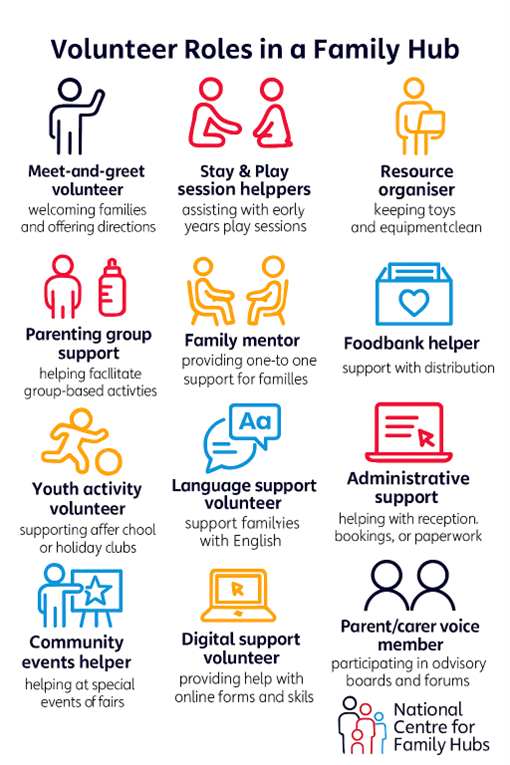
1. Welcome & Front‑of‑House Roles
- Meet‑and‑greet volunteer – welcoming families, offering directions, helping them feel comfortable.
- Reception / admin support – assisting with sign‑ins, paperwork, phone calls, or bookings.
- Hub guide / navigator – showing families around, explaining services and groups.
2. Group & Activity Support
- Stay & Play session helper – assisting staff during early years play sessions.
- Parent–child group support – helping facilitate groups like baby groups, toddler groups, or early learning sessions.
- Youth activity volunteer – supporting homework clubs, youth groups, or informal activities.
- Holiday activity helper – supporting food, play, and enrichment activities during school holidays.
3. Family Support Roles
- Peer supporter / lived‑experience volunteer – offering emotional support to parents based on shared experiences (e.g., breastfeeding, SEND, perinatal mental health).
- Family mentor / befriender – providing one‑to‑one companionship, encouragement, and practical guidance under supervision.
- Community connector – helping families access local services, activities, and benefits or housing support signposting.
4. Practical & Behind‑the‑Scenes Roles
- Resource / toy cleaning and organisation – keeping play equipment clean, safe, and organised.
- Foodbank or essentials‑bank helper – sorting donations, putting together parcels, helping families access essential items.
- Events and outreach support – helping at community events, open days, or local outreach stalls
5. Specialist Skill‑Based Roles
- IT / digital access volunteer – supporting parents with forms, online applications, or basic digital skills.
- Language support volunteer – supporting families with English as an additional language.
- Creative / activity volunteer – offering music, arts, crafts, gardening, or cooking skills for family groups.
- Parenting programme assistant – helping staff set up, take registers, and support delivery (not delivering content themselves).
6. Placement or Career‑Development Volunteer Roles
- Early years student placement – supporting early learning activities under supervision.
- Youth work / social care placement volunteer – observing and assisting with targeted youth or family support (non‑case‑holding).
- Health & wellbeing placement volunteer – supporting health promotion activities (e.g., healthy eating or active play).
7. Governance & Participation Roles
- Parent/carer voice volunteer – participating in advisory boards or co‑production groups.
- Young people’s voice champion – helping shape youth‑focused services.
We delivered a number of Level 2 and 3 childcare qualifications in our Centre, all supported with free creches to enable parents to attend. This also provided the opportunity for the students to undertake placements with us and volunteer in the creche and other sessions.
We had so many volunteers the Centre Administrator was not able to effectively maintain all the records, so we recruited a volunteer as a volunteer co-ordinator. She managed the paperwork, helped with volunteer rotas and was the first point of contact for the volunteers. Prior to her maternity leave she had been a Personal Assistant. The birth of her child had been difficult and she was struggling with not having a regular routine and feeling isolated. Volunteering with the Centre gave her a new purpose and she felt valued and part of the team. Her contribution to the Centre was significant and it was a pleasure to watch her grow and regain her confidence."
Children’s Centre Manager
Solihull have developed a community development approach to develop parent lead services. A small group of parents are now running some sessions themselves using the sensory room and one new Mum is now running stay and play sessions in the local family hubs.
See Case Study for Further Information:
The Brighton and Hove Breastfeeding Team coordinates a volunteer peer support programme. Breastfeeding peer supporters work with women to normalise breastfeeding, boost the confidence of new mothers and signpost them on to other services where needed. The volunteers are given training by the team and there are normally around 30 volunteers at any one time.
Coleen White, one of the volunteers, said the quality of the training is key to the support she is able to provide. She completed a 10 week training programme and spent time in hospital.
“It has equipped me with the latest research, challenges and benefits of breastfeeding, as well as the knowledge and confidence to support women on good positioning and attachment. As a result, I feel confident supporting new mums on the labour and postnatal wards, as well as in the community.”
For the full case study
Brighton & Hove City Council: encouraging breastfeeding | Local Government Association
What qualities make a great Volunteer
Great volunteers in a family hub tend to combine personal qualities, attitudes, and practical skills that support children, parents, and the wider community.
1. Warmth and approachability
They are friendly, kind, and make families feel welcome and comfortable from the moment they arrive.
2. Good communication skills
They can listen actively, speak clearly, and engage positively with both children and adults.
3. Empathy and non-judgement
They respect different backgrounds and situations, showing understanding without making assumptions.
4. Reliability and commitment
They turn up when expected, follow through on tasks, and provide consistency for families and the team.
5. Patience and flexibility
Family hub environments can be busy and unpredictable, so staying calm and adaptable is key.
6. Teamwork
They work well alongside staff and other volunteers, take direction, and contribute positively to the group.
7. Awareness of boundaries
They understand their role, maintain appropriate professional boundaries, and follow guidance from staff.
8. Safeguarding awareness
They recognise the importance of keeping children safe and know how to raise concerns appropriately.
9. Enthusiasm and willingness to learn
They are open to training, keen to develop new skills, and motivated to make a difference.
10. Inclusivity and respect for diversity
They support all families regardless of background, culture, or circumstances, helping create a welcoming environment.
Developing documents for a volunteer programme
Having a clear, well‑structured set of documents is essential to the success of a volunteer programme within a Family Hub. Good documentation provides consistency, clarity and reassurance for volunteers, staff and families by setting out roles, expectations, safeguarding requirements and agreed ways of working. It helps ensure volunteers feel supported, confident and valued, while also protecting children, families and the organisation itself. Robust paperwork underpins safe practice, promotes professionalism and enables the programme to run effectively, transparently and in line with statutory and organisational responsibilities.
Volunteer Strategy
A volunteer strategy is essential for Family Hubs as it ensures a consistent, safe, and effective approach to engaging and supporting volunteers. It helps define clear roles, responsibilities, and standards, while embedding safeguarding, training, and supervision. A structured strategy also strengthens community involvement, improves service delivery, and supports volunteers to develop skills and confidence, ultimately contributing to better outcomes for children and families.
We have created a Volunteer Checklist to support you in developing a volunteer programme.
1. Volunteer Role Documents
• Volunteer Role Description
A clear outline of the tasks, boundaries, expectations, safeguarding responsibilities, and supervision arrangements for the volunteer role.
• Person Specification (optional but recommended)
Outlines skills, qualities, and experience required for the role.
2. Recruitment & Eligibility Documents
Basic personal details, experience, motivation, and availability.
• Identification Documents
Used to verify identity during recruitment and, if required, a DBS check.
(DBS checks require ID verification such as passport, driving licence, or utility bill.)
• References (usually 2)
To confirm suitability for working with families and children.
The Equality, Diversity and Inclusion (EDI) Volunteer Equalities Document sets out our commitment to ensuring that all volunteers, families, and staff are treated with fairness, respect, and dignity. It provides clear guidance on creating an inclusive environment where everyone feels welcome and valued, regardless of background or circumstance. Having this document is essential to promote equality, prevent discrimination, and support volunteers to work confidently and sensitively with diverse communities within the Family Hub.
The Interview
Interviewing potential volunteers in a family hub should be a relaxed and welcoming conversation designed to explore their motivations, values, and suitability for working with children and families. It provides an opportunity to understand their experience, communication style, and ability to build positive relationships, while also assessing their awareness of safeguarding and boundaries. The informal approach helps candidates feel at ease, encouraging honest discussion about their strengths, availability, and any areas for development, ensuring a good fit for both the volunteer and the needs of the hub.
Some suggested Interview Questions can be found here.
3. Safeguarding & Compliance Documents
• DBS Check (if the role is eligible or required)
Most roles involving regular or unsupervised contact with children require an Enhanced DBS with barred list check, depending on the activities involved.
• Safeguarding Declaration
Volunteers acknowledge their responsibility to follow safeguarding policies.
Outlines behaviour expectations, confidentiality, and professionalism.
4. Core Policy Documents (for the volunteer to read/agree to)
• Safeguarding & Child Protection Policy
Explains procedures, reporting, and expectations.
• Health & Safety Policy
For safe working in Hub spaces and outreach settings.
• Data Protection / GDPR Agreement
Required if volunteers access personal information.
• Lone Working Policy (if applicable)
5. Induction & Training Documents
Covers mandatory training, orientation, policies, and hub procedures.
• Training Records
Evidence of completed training such as:
- Safeguarding
- Prevent awareness (if relevant)
- Health & safety / fire safety
- Role‑specific skills (e.g., group facilitation)
We have also developed a suggested content list for an induction pack for a family hub
6. Ongoing Volunteer Management Documents
• Volunteer Agreement (non‑contractual)
Explains mutual expectations and clarifies that volunteers are not employees.
• Supervision / Support Records
Notes from meetings, reflective check‑ins, and development discussions.
• Risk Assessment for Volunteer Roles
Supports safe recruitment and safeguarding compliance, recommended by NCVO.
7. Placement‑Specific Documents (if the volunteer is on a qualification placement)
• Placement Agreement / Memorandum of Understanding
Outlines responsibilities of the training provider and the Hub.
• Hours Log or Practice Evidence Forms
Required for early years, social care, youth work, or similar qualifications.
Important Note on DBS for Students
Students on formal placements are not considered “volunteers” for DBS purposes and may require a paid DBS check depending on role and setting.
Working with Stakeholders
Organisations linked to family hubs often rely on volunteers as a valuable part of their wider approach to supporting children and families. Here are examples of some volunteer programmes:
Parent Champion Programme
Coram Family and Childcare have developed a Parent Champion Programme. Currently 38 schemes are running across the Uk, with 424 parent champion volunteers and reaching 41491 families per year.
Parent Champions are parent volunteers who give a few hours a week to talk to other parents about the local services available to families. Coram Family and Childcare developed the Parent Champions programme in 2007 to help marginalised or isolated parents who miss out on vital information about how to access local family services.
The Parent Champions model is delivered by parents for parents, with the support of a local authority, children’s centre, Family Hub, school or local community organisation.
Parent Champion programmes can be developed to meet different needs for example:
- Early Education and Childcare
- Home Learning Environment
- Special Educational Needs and Disabilities
- Resilient Families
- Community Connections
Further information is available from their website
https://www.coramfamilyandchildcare.org.uk/parent-champions/setting-up-a-parent-champions-scheme/
Home Start Host
Home-Start HOST is a local charity of trained volunteers and dedicated, experienced staff. They help families with young children flourish during the years of early childhood, supporting parents across Tameside, Oldham, Stockport, Bolton & Glossop.
Their support is compassionate, confidential and non-judgemental. They know how tough parenting can be and the difference the right support can make.
They offer a range of support, from one-to-one support in the home to specialist early learning, breastfeeding and perinatal support.