Northumberland Archives applied to the National Lottery Heritage Fund (NLHF) for a project to make manorial records more accessible to all and to help people use them both creatively and for research. This has been achieved through a combination of transcribing, digitising, and engagement activities, including education sessions with Key Stage 2 pupils. In total, 63 volunteers have contributed over 4,000 hours of time to the project.
The challenge
The Manorial Documents Register for Northumberland was revised in 2014-2018 and made available online. This increased awareness of manorial records locally, but Archive staff noticed that people who could benefit from using these records for their local and family history research were not doing so, partly through lack of awareness of the records and partly because many felt that they were too difficult a source to use. The challenge was to make these important records accessible to all, not just academics, by removing the fear of the unknown, and demonstrating the range of content that the records contain.
The solution
The archives applied to NLHF for a project to make manorial records more accessible. £73,100 was awarded, which enabled the Archives to employ a part time project archivist, digitise a range of original manor court records to supplement existing images, and carry out associated activities. The grant was awarded in late 2019, but the project was delayed until Spring 2022 because of the pandemic and will finish in early 2025. The delay worked to their advantage because it was now feasible to add a remote-volunteering element to the original proposals, attracting contributors from around the county and beyond.
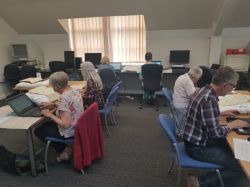
The core of the project was the engagement of volunteers in four localities – Allendale, Berwick-upon-Tweed, Hexham and Newcastle-upon-Tyne. Some of these volunteers were from local history societies. The cohort also included three student placements from Strathclyde University. The volunteer task was to transcribe sample manorial documents from manors across the county. Training and support was provided to de-mystify the records and assist with palaeography. Images were uploaded to a Google drive so that they could be accessed remotely. Volunteers have been able to work on any of the locations, and on documents that interest them if they wish, such as those relating to their own house or ancestors. Some of the Berwick group meet weekly in person, but other volunteers work from digital scans of documents.
Talks, workshops and conferences have been held around the county to introduce people to manorial records and how they can be interpreted. Sessions have also been held with Key Stage 2 pupils in which staff were pleasantly surprised at how engaged pupils were with documents relating to Hexham’s market. Animations created by the children are available on the archives’ YouTube channel.
The impact
Completed transcripts and associated images are being uploaded on a section of the archives’ website, dedicated to the project. This includes supporting resources such as a glossary, map, FAQs, introductory video, notes on the histories of individual manors, guides to the Manorial Documents Register and teaching resources for pupils and lifelong learners. These allow researchers to learn about typical formats and contents of manorial records.
63 volunteers have contributed to the project to date and, as well as benefitting the aims of the project and their own research interests, the social aspects of the project help to reduce isolation among the cohort, contributing to the council’s Wellbeing agenda.
Northumberland is a large rural county, with limited public transport options. Use of remote technology has enabled the project archivist to assist volunteers without necessarily travelling each time, saving time and fuel, but also allowing more volunteering to take place than originally planned. Over 4000 hours of time have been contributed to the project.
How is the new approach being sustained?
The website will provide a lasting legacy of the project, acting as a portal for a growing suite of resources which can help users new to manorial records learn what they might contain, and how to use them. This helps to make an underused class of records accessible to many more users, of all ages. The accompanying learning resources can be re-used in future years to encourage even more people to investigate manorial records.
It is hoped that many of the volunteers will continue to work on new projects for the archives, which can build on the experience and techniques of the manorial project.
Lessons learned
Northumberland Archives has learnt that providing high quality and relevant training to volunteers is essential. This time investment has upskilled volunteers who can then move on to other projects as they become available. It has also helped build up volunteers’ confidence in undertaking the work and helped us shape the format of the external workshops. As a large rural county, running a remote volunteer project was a better use of the Project Archivist’s limited time and allowed more people to be involved within Northumberland and beyond. It also meant that volunteers could fit their work around their own availability instead of being limited to archive opening hours which promoted accessibility.
Finally, the project has shown the importance of delivering events in the local community and not expecting people to visit the archives which has limited opening hours. The impact of this cannot be underestimated.