Durham has participated in the National Recruitment Campaign for three years, as the North East region was involved in the regional Pilot back in quarter one in 2024. The four resourcing leads have extensively leveraged the LGA Campaign Toolkit to address longstanding recruitment challenges.
Key achievements at a glance
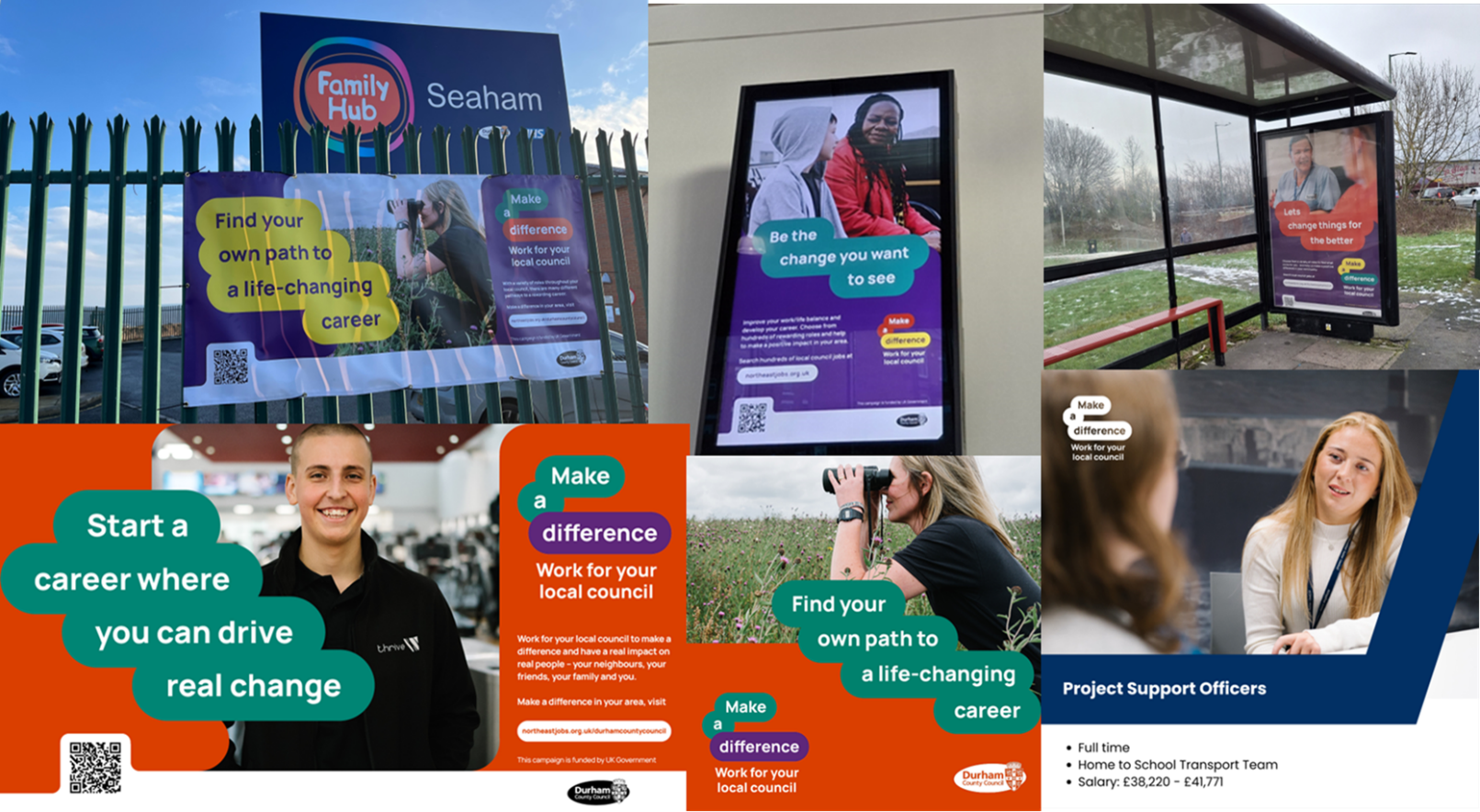
- Significant year-on-year increase in job applications, advert views and careers webpage traffic: "We have had an increase across all roles in terms of applications, advert views, hits to our website... it’s trending upwards in the last three years."
- Improved applicant quality, leading to higher shortlisting rates across roles: "The quality of applications is increasing… we are shortlisting more people than we did previously."
- Greater strategic use of promotional channels including adshels (e.g. six-sheet poster sites at bus stops), family hubs, and digital screens: "The adshels… have worked well every time we’ve used them."
-
Successful integration of authentic local council employee imagery to drive engagement.
-
Enhanced cross-team targeting of harder-to-fill specialist roles and entry-level roles.
Background
Durham County Council (Durham, ‘the Council’) is one of the largest local authorities in the UK, with around 8,500 employees supporting a diverse range of public services across a wide geographical area. Its ‘Workforce Strategy 2024 - 2027’ outlines a commitment to maintaining a stable, skilled and resilient workforce capable of delivering long‑term priorities for the county, including: housing, jobs, transport and environmental goals. The strategy emphasises modern HR practices, strong workforce planning, and aligning talent development with the Council Plan to ensure “the right people, in the right roles, doing the right thing” for residents.
Durham has participated in the National Recruitment Campaign for three years, as the North East region was involved in the regional Pilot back in quarter one in 2024. The four resourcing leads have extensively leveraged the LGA Campaign Toolkit to address longstanding recruitment challenges.
Like many other local government organisations across the country, Durham faces skills shortages in specialist professions such as: legal (Lawyers), residential care managers, adult care workers, social workers, educational psychologists and niche roles in the arts, culture and ecology. Roles where there is a higher turnover in personnel like leisure, can also present challenges too. More generally, it is often difficult to compete with private sector competition for these roles, where higher salaries are offered. The Council were also keen to target early‑career applicants and parents returning to work.
The Council’s resourcing team emphasises authenticity, using real employees and local landscapes to ensure recruitment messaging feels relevant to County Durham residents:
"They just know when something is fake… we’ve always said we need to be real and authentic, and it gets us results." said the Durham Council's resourcing team.
Objectives
1. Increase visibility of Council career opportunities across the county.
2. Capitalise on increased traffic to their job pages online over the period of the paid media national Campaign.
3. Boost applications for both specialist roles where there are longstanding and acute skill shortages and also entry‑level roles to address the ageing workforce by targeting school leavers and college leavers. There was a recognition here that engaging the early careers or first job segment was tough: “the Council can be viewed as sort of grey and boring, it’s only when you get to middle age and you realise that flexible working and a good pension, are really valuable to you, but that's quite a hard sell to somebody who's a school leaver, who sees the Council as somewhere where their grandma works or their mum works.” More positively there was a feeling that Gen Z do want to make a difference and do work that is meaningful.
4. Improve applicant quality and fill rates, particularly in hard‑to‑recruit areas.
5. Align a major local recruitment push with the National Campaign paid media activity in January 2026: "We always have a spike when this campaign runs."
6. Strengthen engagement with younger talent and mid‑career professionals.
Approach
Durham County Council applied a strategic, multi‑channel approach, informed by lessons from prior years: "This year has probably been the first time that we have been more strategic… and thought what has worked well and what should we put our money into." The team “fine-tuned” its use of out‑of‑home advertising, prioritising adshels over bus backs due to better reach across the county and the value of exposure based upon higher dwell times, frequency of repeat and over-show, etc:
…if you're passing the same bus shelter every morning and every night over a period of a fortnight, you're going to see it, you know, seven times a week, 14 times a week, 20 times a week.” said a member of staff at the Durham County Council.
The Council leveraged high‑footfall locations such as the 15 ‘Best Start’ family hubs, leisure centres, libraries and cultural venues, placing vinyl banners and using digital displays to maximise visibility. This ‘in community’ marketing was supported by social media activity throughout, alongside video case study films originated by the Council.
As a member of staff at the Council explained the visibility and presence in family hubs was thought to have dual benefits :
…there's a lot of footfall that goes through there (family hubs)…so definitely the amount of people who I think we could touch…but also just about families wanting better starts or wanting to make improvements and maybe some of those parents aren't working and are thinking about working…we thought it hit both aspects really.” said a member of staff at the Durham County Council.
Harnessing the digital displays in leisure centres, libraries and cultural venues, was both an effective and cost-efficient media resource, as it was:
utilising space that we own…that’s also getting good footfall.” said a member of staff at the Durham County Council.
Each asset sourced from the Campaign Toolkit was customised through the incorporation of images of real employees working at the Council in order to maximise authenticity and perceived relevance locally:
We wanted to highlight real jobs, in real places.” said a member of staff at the Durham County Council.
This sits at the heart of how the Council approaches recruitment marketing:
We feel that all we do needs to be authentic and real and it gets us results. So, that is our ethos on anything talent acquisition. We've always said that what we need to do, is open the doors to Durham County Council and show people what it's like to work here.” said a member of staff at the Durham County Council.
The local imagery assists the representation of the county overall, avoiding a charge or perception of bias, towards the city of Durham itself.
Close collaboration between HR and Communications enabled alignment with local priorities, while recruitment pushes were timed deliberately for January to February to benefit from National Campaign activity including radio and digital channels:
…we release them in January so that we are really leveraging the additional promotion." said a member of staff at the Durham County Council.
From a messaging perspective, the activity locally put a focus on ‘New Year, New Career’, with it being a January-February campaign. The ‘fantastic’ council rewards and benefits were also highlighted in the adverts.
Impact
1. Growth in applications, advert views and website hits over a three year period.
2. Noticeable spike each January due to alignment with National Campaign activity:
“We benefit from BIG campaign impact, without us incurring BIG campaign costs.”
3. Increased shortlisting rates and improved candidate quality reported by hiring managers: "We shortlisted 70 odd out of 198 applications… that is unusual...the quality is there."
4. Strong performance in specialist areas such as social work and food waste operatives:
"On the whole, social work applications… the vacancy rate is the lowest we’ve had in a long time."
5. Greater public awareness of Council career opportunities via localised authentic imagery.
6. New employees, such as those recruited mid‑career, reported smooth, positive recruitment experiences and the Campaign messaging resonated with them: "I work in fraud…it’s one of those roles, I thought that maybe I can make a bit of a difference…I quite enjoyed the (recruitment) process… it was fair and open...The Council were very interested in my experience and that was quite refreshing."
Learnings and reflections
Durham’s experience highlights the value of early engagement with hiring managers, ensuring local activity runs at the most impactful times:
-
"It’s one of our biggest challenges to get all hiring managers to do the same thing, as there are hundreds and hundreds of them."
-
Could more be done in future nationally, to support and assist hiring managers, in thinking and planning ahead? “Maybe the next step for the National Campaign, is really to touch those hiring managers.”
-
Inconsistency in the behaviour of hiring managers and the briefing of recruitment requirements presents major challenges.
-
Buy-in to the leveraging of Toolkit assets may also be more widespread, if the hiring managers were more informed and on-side regarding the Campaign.
The Council believes that the paid media National Campaign is well-timed in January-February to coincide with when many people are looking for new opportunities. They really value the increased visibility delivered by the national promotion, and the radio advertising – which is a media that is difficult for a local council operating alone to tap into. In previous years the Council has seen a significant increase in traffic to their website during the Campaign period and this has built up the confidence to plan for and around that uplift.
Authentic photography remains essential, as nationally produced assets can feel disconnected from local identity with regard to: place (landmarks), ethnic mix and social setting, etc. But this local photography is easily integrated into Campaign Toolkit assets.
Referral pathways and internal communications offer further opportunities to amplify recruitment messaging. Could more be done to encourage, assist and support referral by existing Council employees, as one recent new recruit commented:
I was just fortunate that I have a friend who works for the Council and there's something there about people who work for the Council, being your best advert, I guess, really.” said one of the new recruit at the Durham County Council.
The Council sees ongoing value in the Campaign Toolkit and believes more authorities could benefit from using it to increase visibility and leverage national activity while tailoring messaging to local needs:
"The Toolkit improves every time… the support improves every time." said the Durham Council Team.
The potential for newly recruited employees to deliver a local or community impact, can really resonate very strongly: “…it was purely about making a difference at a more local level, maybe using my skills at a local level, because hitherto I was very much playing on the national stage and feeling perhaps I was a very small cog in a huge machine, whereas working at the council, it feels very much different.”