The Planning Advisory Service (PAS) Local Plan Route Mapper is designed to help you navigate the plan making process.
Introduction to the Route Mapper
The Planning Advisory Service (PAS) Local Plan Route Mapper (hereafter referred to as the ‘Route Mapper’) is designed to help you navigate the plan making process. Drawing on the experience of sector experts and plan makers across the country, the Route Mapper provides a framework to help generate creative responses to the procedural and technical requirements to enable efficient and effective plan making and delivery of positive ‘real world’ outcomes.
The Route Mapper is focused on helping you to undertake a review and/or update of your local plan or joint local plan (as distinct from a mayoral or combined authority Spatial Development Strategy as defined in Annex 2 of the National Planning Policy Framework (NPPF), or neighbourhood plans).
The Route Mapper includes advice on:
- Navigating the process of reviewing local plan policies, including advice on how to consider whether to update a local plan and the extent and scope of that update (i.e. whether a full or partial update of policies is necessary)
- Scoping and preparing your local plan update, setting out ways to design an efficient and effective plan making process that reflects national planning policy and legal requirements, including tips on how to anticipate and navigate risks and challenges along the way
- Developing the update to your local plan, explains how to employ a robust method of plan making, to help you make sure you are only investing in tasks critical to plan production and avoiding wasteful activities that add limited or no value to the plan process or outcomes. It will also help you to create local plans that are easy to use and understand whilst still meeting the necessary legislation/regulations, NPPF, PPG, and the tests of soundness
- Consulting and engaging on the update to your local plan, in an efficient and effective way, setting out the legislative requirements and advice on more creative and engaging approaches that could benefit your plan
- Developing the submission version of the local plan update, detailing the purpose of delivering a comprehensive Regulation 19 Submission Local Plan publication document, with guidance to the steps that need to be undertaken prior to publishing the plan to ensure that you have all the relevant supporting evidence for submission. It also gives practical advice on how to proceed to independent examination
- Independent examination and adoption, setting out the procedural steps of an independent examination and how to successfully prepare for them, including practical advice on how to organise your response to ‘Matters, Issues and Questions’ and engaging with stakeholders.
The Route Mapper document is supplemented by a Local Plan Route Mapper Toolkit (hereafter referred to as the ‘Toolkit’) – which you can use at different stages of plan making to check that your plan is heading in the right direction.
The Route Mapper and associated Toolkit are based on advice and experience from practitioners and include a series of ‘Lessons Learned’ from Local Plan Support provided to authorities by PAS in recent years. The content has been tested with experienced local authority planners across the country and informed by conversations with leading consultants in the plan making field. However, it does not represent formal policy or guidance for plan makers. While this advice aims to explain how local plan making requirements will work in practice, any interpretation of the regulations and national planning policies is offered only as a guide and does not remove legal risk or challenge. It is therefore important to read and understand the regulations as well. In cases of doubt independent legal advice should be sought.
Further, the Route Mapper and Toolkit shouldn’t be seen as a definitive view on how plan making should be undertaken although it is based on the experience of those who have been involved in the process – creative and innovative approaches that are relevant to your local context should always be pursued. Instead, this Route Mapper and Toolkit provides a useful starting point for thinking through plan making issues and helping you to navigate the process. This might be particularly helpful if you are new to a role leading on plan production or want to make sure that you have taken into account the most up-to-date plan making requirements and ‘best practice’. PAS will aim to keep this document up to date to reflect changes to legislation and guidance and examples of best practice – so it evolves as plan making practice evolves.
Local planning authorities are required to review, at least every five years, whether their local plan policies are up-to-date. At the end of the review process you must conclude whether or not policies in the local plan need to be updated and publish reasons for your decision. If you determine that an update is required to any policies of the adopted local plan, (or that you need to produce a new local plan), you will then need to establish your process and timetable for the update, culminating in the publication of an updated Local Development Scheme.
The Route Mapper and Toolkit acknowledges that the scope of any local plan update may vary from a small-scale partial update of specific policies, through to a full update which could potentially result in the production of a new local plan or a joint local plan. The Route Mapper and Toolkit can be applied to any scenario of update being undertaken, but you should apply the advice provided pragmatically and proportionately to reflect your own plan-making circumstances and context.
The advice included in the Route Mapper is aimed at officers. However, councillors may find it useful in helping to understand the plan making requirements and the opportunities they present. Statutory consultees, local communities, infrastructure providers and the development industry may also find elements of the advice useful in framing their engagement with the plan making local authority at various stages in the process.

Navigating the process of reviewing local plan policies
The local plan making journey should start with reviewing policies to determine whether it is necessary to update your local plan. There is a legal requirement to review local plan policies at least every five years from the date of its adoption along with your Statement of Community Involvement. This requirement is set out in Regulation 10A of The Town and Country Planning (Local Planning) (England) Regulations 2012 (as amended) and NPPF 2024, paragraph 34. In practice you may need to review your local plan policies in advance of this five-year requirement.
This section of the Route Mapper provides an overview of one possible approach that you can follow in undertaking a local plan review. In practice the approach to review cannot be entirely uniform, because it will vary depending on your authority and the unique plan making challenges you face. In the majority of instances, a review of local plan policies is likely to result in the need to update specific policies or parts of a local plan. Therefore, any conclusion to not update a local plan following a review of policies should be carefully reached, and in publishing your decision you will need to be able to provide clear evidence and justification.
In undertaking the review, you will need to take into consideration policies in all of the development plan documents that make up your development plan as including any ‘made’ Neighbourhood Plans.
Part 1 of the Toolkit provides an assessment template to take your through detailed consideration of a range of factors that you will need to consider when undertaking a review of your plan policies.
You can use this in tandem with Part 2 of the Toolkit which provides a quick reference list of the core NPPF requirements for local plan content; this can help you assess your existing local plan policies against current national planning policy.

Scoping and preparing your local plan update
The first stage of the local plan update should involve defining and planning your approach from the beginning to the end of the process. This means putting in place a robust approach to project management and defining the scope of your local plan update. This is important for a number of reasons including to provide a good understanding of the resources (people and money) likely to be needed, helping others to understand when they need to gear up to be able to respond to key stages, and ensuring that the Planning Inspectorate (PINS) is able to resource an independent examination. The following section provides an overview of the process which you may wish to consider.
Parts 2 and 3 of the Toolkit will assist with these stages of the process. Part 2 can assist with scoping the local plan update and part 3 highlights procedural requirements for this stage of plan making.
Case study: Plymouth City Council – Richard Grant, Strategic Planning Manager
In 2004 the Council started work on its Core Strategy (as part of the then Local Development Framework planning policy approach). This started the process of thinking about planning policy development as something other than developing a rule book. Instead the focus was on creating a visionary document for the community about the transformation of the city.
The Core Strategy enthused people and caught the imagination. It had a sense of vision, drive and direction by focussing on telling the story of what the place could become. This is something that we have tried to retain in subsequent plans including the Plymouth and South West Devon Joint Local Plan which we adopted in 2019. We started work on the Joint Plan in February 2016 and submitted it for independent examination in July 2017.
National policy tests for plan making are in some ways becoming more process led. This primarily relates to requirements on housing need, supply and the five year land supply. If the need number you have is not comfortable, you still need to face up to it! We have a housing crisis and the planning system needs to find ways to resolve it and not try and hide from it. You have to be honest with your councillors about what you have to plan for.
In Plymouth we had an advantage in that the Council wanted to embrace growth. We started off from a good place of not trying to side step the housing need and the affordability challenges and we upped our numbers above our standard methodology figure. In doing a Joint Local Plan we can articulate the response to rural areas with environmental constraints. Explaining these constraints in the context of a growing city at the heart the area is an easier story to tell.
The other part of the jigsaw is supply. We went to town on understanding it. We set out our site supply methodology and trajectory in such a way that we know how it will be delivered from now to 2034 – the whole plan life. The five-year land supply has lots of ‘wriggle room’ and the trajectory includes a 13 per cent buffer. This meant there was limited challenge at the independent examination as the Inspector could tell it was a well-constructed plan. We’ve also been able to use this as a tool with developers to both challenge them about, and coordinate with them on delivery. When a developer’s site delivery is lagging behind, we move them to outside the five-year land supply as we have enough headroom and currently have 6.7 years of supply.
If you nail the ‘rock’ of the plan which rightly or wrongly is about housing, this allows you to have the other more visionary elements – the ‘creative stuff’ which tells the story of your place. You need to have an awareness of the balance between these creative and process elements; a local plan needs to be robust but don’t lose the visionary plan making aspects.
What’s been missing over the last few years in the language of plan making is the word ‘spatial’. I see this as being about a more holistic understanding of the things that make a place work beyond just the use of land. The process aspects can make it seem like the plan making system is being done to you rather than it being a tool for you to do good. But if plan making isn’t creative I don’t want to do it anymore! Think of the process as a tool to achieve your ends. We started with what we think is the answer for our community and what Plymouth and South West Devon could be. We set out that vision first and then used the legislation and the NPPF to achieve that vision. I think that is what planning is all about.
Developing the update to your local plan
The next stage involves the actual development of your updated local plan. You should start with developing your evidence and on engagement with key delivery partners and stakeholders.
The Toolkit (parts 2, 3 and 4) can assist here.
Part 2 of the Toolkit provides a quick reference list of the core NPPF requirements for local plan content; and is a useful reminder of what your policies update needs to cover.
Part 3 of the Toolkit highlights some important procedural requirements for this stage of local plan making.
If you are developing a full update of your local plan or a new joint local plan, you may find the assessment matrix in Part 4 of the Toolkit helpful in informing the development of policies and identifying issues. If you are undertaking a partial update of your local plan, pick out the key questions relevant to your update.
Consulting and engaging on the update to your local plan
The approach to consultation and engagement will vary depending upon the scope and extent of the local plan update and local circumstances. As a minimum, under the Regulation 18 stage you must notify relevant organisations (as defined by the Regulations) of the subject of the local plan update and invite each of them to make representations about what the local plan update ought to contain. You must then consider the representations made. However, where you are undertaking a full or extensive update to your local plan, it may be prudent and appropriate to undertake public consultation on the draft local plan update together with supporting documents (i.e. a full version of the draft local plan). This section relates to consultation carried out before the Regulation 19 stage, but elements will also be applicable to the Regulation 19 publication or main modifications consultation.
Part 3 of the Toolkit highlights some important procedural requirements for this stage of plan making.
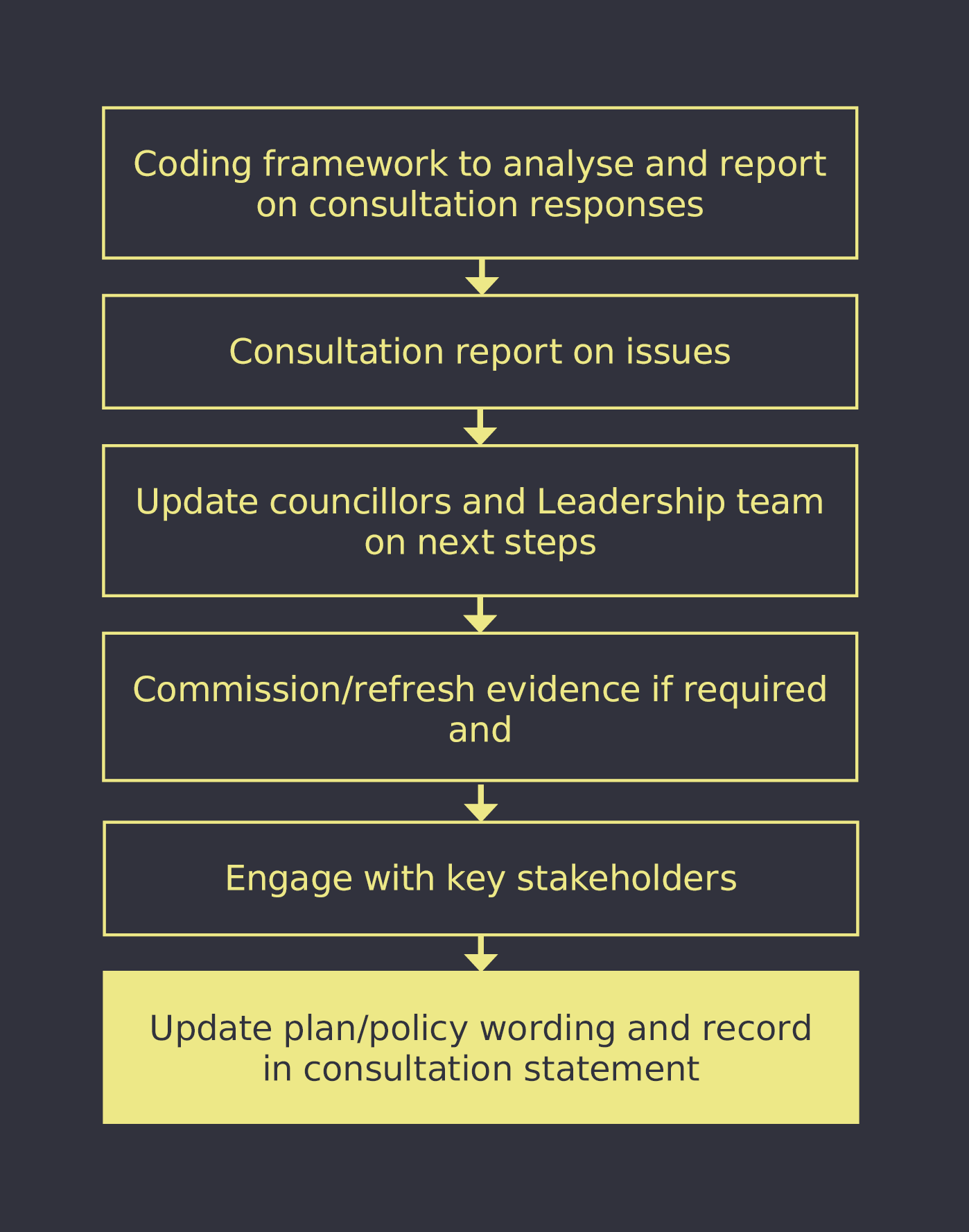
Case study: Ashford Borough Council – Simon Cole, Head of Planning Policy
Ours is a typical planning context in the south east with the main issue being delivering housing growth whilst maintaining environmental/countryside protection. In Ashford there was significant community concern around speculative applications in locations that were not appropriate. Understandably there was also frustration from our councillors about the limited capacity available as resources were being diverted to appeals in the context of the challenges around maintaining our five-year housing land supply.
Our starting point was to get out into the community to have a grown-up conversation with residents and parish councillors about the challenges we faced. You need to be 100 per cent transparent in the way in which you explain the issues to your community and you need to be clear about what your Statement of Community Involvement says.
Ashford haven’t used ‘issues and options’ style documents as a rule although there are instances in which they can be helpful to build consensus around approaches. We started with ‘Plan Ashford’ which was really a series of conversations to understand what the issues were. We then did a ‘call for sites’ exercise and a series of exhibitions jointly with the parish councils. We simply presented the available sites on a map without indicating their suitability. We used this as a basis for discussions with communities on what their thoughts were on these sites – the issues and opportunities. We then did some more targeted engagement as part of the Regulation 18 stage including with different sections as the communities but did not publish this formally as a draft for consultation.
Understanding what your plan is seeking to achieve is key. In terms of developing the strategy, you need a clear narrative – and that narrative needs to be underpinned by evidence. Don’t start from sites to develop the strategy as you don’t always meet in the middle!
An independent examination is all about preparation; you can’t wing it! Hearings are not public inquiries and there is a limited role for advocates – they should be evidence led.
Being able to point the Inspector to evidence and articulate why you have made certain choices – and how you have exercised your planning judgement is key. This can mean that you have allocated the ‘best site’ based on a strategy decision rather than consideration of the site ‘scores’ in isolation; but you have to be able to justify and explain this. Being able to point an Inspector to the relevant section of an evidence document whether in statements or during hearings inspires confidence.
We have now adopted our plan, and the reality is we keep our situation under review in terms of land supply and keep an eye on delivery. But having the plan in place has given clarity to our development management officers who were previously dealing with policies in multiple documents and has given confidence to our councillors.
A local plan must define a strategy – and together with supporting documents – tell the story of why this is appropriate. The strength of a local plan is based on two pillars: consultation and evidence gathering. You need to approach these proportionately and get the balance right between them.
Developing the submission version of the local plan update
The next stage of plan making is preparing your Regulation 19 Submission Local Plan update. The publication of your Regulation 19 Submission Local Plan update is not a consultation stage. Rather it is the point at which you publish the updated local plan that you intend to adopt, having been informed by earlier consultation and engagement, and that you are seeking representations under Regulation 20 on its soundness and legal compliance. The plan that is published at Regulation 19 stage should be the plan that you intend to submit to the Planning Inspectorate for examination.
Parts 3 and 4 of the Toolkit are of particular relevance. Part 3 highlights key procedural requirements for this stage and Part 4 can assist in providing a final check of policies and identifying issues and any changes that might be needed before publication.
Independent examination and adoption
This section of the Route Mapper sets out guidance on the independent examination stage and beyond. PINS has provided specific guidance on procedural requirements associated with local plan independent examinations: Procedure Guide for Local Plan Examinations 2024 and published a collection of local plans guidance and information.
Part 3 of the Toolkit highlights some important procedural requirements for this stage of plan making.
Further support / Key plan making documents
Our priority is to help councils get an up-to-date local plan in place as soon as possible, so that places have local plan policies to steer development and make local decisions. The Route Mapper and Toolkit will help you to make this happen and to understand what needs to be done to get a good plan in place. PAS can work directly with local authorities to use the Route Mapper and Toolkit as a "critical friend" or provide an advisor from our team of experienced local authority peers or our team of consultants.
If you would be interested in accessing this support please contact [email protected].
Links to the key plan making related documents referred to in this advice are set out below for ease of reference:
- National Planning Policy Framework (2024)
- National Planning Practice Guidance
- Information and resources for local planning authorities on creating a local plan (note that some advice may relate to local plan production under the ‘new’ plan making system)
- PAS Statement of Common Ground Advice and Template
- PAS Local Plan Support – Lessons Learned
- PAS Guide to better Sustainability Appraisal
- PAS Local Plan Evidence Base guidance
- Local Plans: guidance and information from the Planning Inspectorate
- PINS Procedure Guide for Local Plan Examinations (2024)
- PINS Local Plan examination process
- PINS Model representation letter for local plans (2024)
- Strategic Environmental Assessment Directive: guidance
- Habitats Regulations Assessment: protecting a European site
- General Data Protection Regulation Guidance and Resources
Local Plan Route Mapper Toolkit
The Toolkit sits alongside the Route Mapper in order to assist local authorities to undertake a Local Plan review, project plan, manage and carry out the update of a Local Plan.
The Toolkit is comprised of four parts:
Part 1
A succinct form to help you to undertake a review of your plan policies to assess the need for a local plan update.
This can be used to help you address the requirement to review the local plan at least every 5 years and whether you then need to update your local plan either in part or in full.
Part 2
Local plan form and content checklist
Helps you to assess the content requirements for local plans based on the National Planning Policy Framework (NPPF).
This can be used to check that your plan covers the matters prescribed in legislation, the NPPF and PPG when you are reviewing your local plan using Part 1 of the Toolkit. . It also provides a good final check point before you consult or engage under Regulation 18 or publish under Regulation 19 prior to its submission for independent examination.
Part 3
Local plan process requirements checklist
A checklist of procedural requirements for preparing local plans and some of the most important project management implications arising from these.
This can help you with project planning and to check that you have complied with relevant legislation and regulations relating to how you should prepare and consult on a local plan update at each stage of plan making.
Part 4
Local plan soundness and quality assessment
A local plan assessment matrix
Inspired by typical independent examination questions, this is not a checklist! It is a rigorous risk assessment tool that you can use to assess your level of confidence in your plan throughout the plan-making process. It will help you to identify and assess any problems and issues and to identify actions that may need to be taken to address these – and push beyond these to create a better plan. It is intended for use particularly in assessing the early drafts of the local plan and will also be beneficial to utilise before you publish the Regulation 19 Submission Local Plan update.