On Thursday 11 June, the LGA marked the International Day of Play with a Lunch and Learn session discussing play sufficiency and its case for being treated as a public health priority. Speakers included Dr Wendy Russell (University of Gloucestershire), Mike Barclay and Ben Tawil (Ludicology), and Tracey Jobber (Play Services Manager, Sandwell Metropolitan Borough Council).
The session centred on “Playing and Being Well”, a 2024 literature review examining the relationship between children's play, wellbeing, and the conditions that support both. Drawing on over a decade of research into the Welsh Play Sufficiency Duty, the first national legislation recognising children's right to play, speakers explored how play sufficiency is emerging as a powerful framework for improving population health.
The evidence: how play interacts with health and wellbeing
Dr Wendy Russell outlined the physical, social, and cognitive benefits children gain through play, both for their health and wellbeing today and for their future lives as adults. These range from creativity and innovation to fundamental movement skills. She also highlighted a less obvious point: play lets children experiment with raw emotions without the real-world consequences such expression might normally carry, helping them build emotional regulation and healthy stress responses.
Play is also how children participate in and feel that they belong to their community - it's how they form attachments to friends, adults, places, and objects. On top of this, play encourages social cohesion more generally: the review found that in areas where children do play outdoors, there is also more social connectivity between adults.
Given this weight of evidence, Wendy argued that play sufficiency (children having enough time, space, and permission to play) should be recognised as a determinant of children's health. "This shouldn't have to be a radical suggestion," she said, "but it feels as if it is."
Trends in play
The review painted a mixed picture. Children continue to show a lively culture of play across many contexts, but stark, intersecting inequalities and spatial injustices increasingly constrain their ability to play. Key drivers discussed include:
- the lasting effects of late capitalism, including the 2008 financial crisis and subsequent austerity
- growing commercial influence over play – such as toys, digital technology, and paid-for play provision - pushing play out of reach for some children
- changes in public space contributing to a steep decline in children’s everyday freedoms, such as the dominance of traffic, increasing privatisation of public space, and concerns over neighbourhood safety and structural marginalisation.
Children still express a strong desire to play outdoors with friends, and do so where conditions allow - but for many, the realities of their daily lives make this increasingly difficult.
Play sufficiency and how to increase it
“When conditions are right, children can create their own wellbeing”
At the heart of play sufficiency is the principle that, if the conditions are right, children will play. Our responsibility as adults is to co-create those conditions with children.
Ben Tawil set out practical ways local authorities can build play sufficiency, starting with establishing the current "state of play" through children's own reported experiences and play patterns. Suggested methods include:
- Quantitative online surveys establish generalised trends in play patterns and track progress over time, and to allow comparison and identification of areas with particularly positive or negative reported experience for in-depth case study work. Ben recommended focusing on specific indicator age groups, such as children in years 5 and 9, and repeating the survey at the same time of year each year.
- Policy SWOT analysis identifies strengths and gaps across departmental policies relevant to play.
- Qualitative, hyperlocal research helps explain what sits behind survey results. This commonly includes spatial audits of neighbourhood opportunities for play and children's independent mobility, plus mapping activities with children themselves - recognising that they often experience their local area differently from adults.
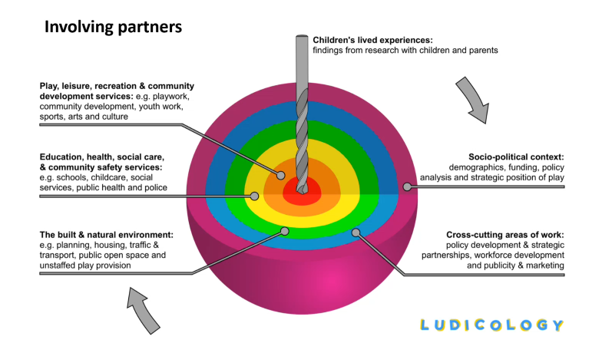
These assessments can feed into strategic priorities, action plans, and Joint Strategic Needs Assessments, embedding play sufficiency as a local priority. The process itself can strengthen partnership working and shared recognition of collective responsibility for play - bringing together policy, planning, housing, transport, public health, education, community safety, and play provision to understand how decisions across these areas shape children's time and space for play.
Working across departments – a case study from Sandwell
Tracey Jobber described how play sufficiency has become a key driver of partnership working and system change in Sandwell, and a delivery mechanism for a wider child-friendly agenda.
"It's not just about playgrounds- it's about embedding children's right to play across environments, services, and planning decisions."
She stressed the importance of engaging departments that wouldn't normally see themselves as relevant to play, repositioning it as a shared responsibility. Sandwell's approach has included:
- a cross-departmental implementation team, using workshops and shared data
- mapping assets and gaps across neighbourhoods
- integrating findings into planning and service design
- building shared ownership of outcomes.
As a result, colleagues across the council now recognise their own role in supporting play, leading to more coordinated and responsive services. The process has also fostered new working relationships, with knowledge, skills, and ownership gradually being shared across departments, which in time will serve to reduce reliance on a single central function and support a more sustainable, embedded approach.
To summarise, the speakers made the case for play sufficiency as a unifying principle capable of bringing departments and partners together, shaping policy across multiple areas, and standing as a public health priority in its own right.
Contacts
- Mike Barclay, Director at Ludicology
- Ben Tawil, Director at Ludicology
- Dr Wendy Russell, Senior Research Fellow in Play at University of Gloucestershire
- Tracey Jobber, Play Services Manager at Sandwell Metropolitan Borough Council