Introduction
The LGA’s Sector Support Offer provides practical support to council and combined authorities in England to help strengthen leadership, performance and resilience to respond to challenges and opportunities.
A clear strength of the LGA offer is access to experienced councillors and officers who understand local government first-hand and can provide confidential trusted advice, challenge and support.
The LGA’s support is founded on the principles of Sector Led Improvement (SLI), which recognise that support is most effective when it is delivered by the sector, for the sector.
This toolkit recognises the unique value of the voices of those who receive and deliver support, who are well placed to advocate on behalf of the offer. It aims to enable ‘ambassadors’ to actively champion the support and raise awareness to make more councillors and officers aware of the benefits it provides, understand what is available, and how they can engage.
This Sector Support ambassador toolkit provides a set of clear messages, practical resources and ready-to-use materials. Whether speaking to councillors, officers, government or wider partners, the toolkit is designed to help communicate the offer confidently and effectively including to demonstrate its impact and value, and signpost to relevant support.
How to use this toolkit
The toolkit is designed to be used flexibly. You might use it to:
- share experiences of delivering support with your networks, including on social media
- share information about offers you wish to promote through your networks, including social media
- signpost colleagues to relevant programmes and regional teams contacts
- share evidence of impact and value for money, including support which your authority may have accessed and any improvements this has contributed to
- Prepare for conversations with councils, members or officers about improvement support.
Who this toolkit is for
This toolkit is designed to support:
- councillors and officers who are representing the LGA’s Sector Support Offer, for example, as deliverers of support or IDeA Board /Improvement Committee Members
- councillors and officers accessing support to share with others in the sector about their experience.
Communications objectives
This toolkit aims to provide members and officers communicating about the Sector Support Offer with top tips and guidance to:
- increase awareness and understanding of the LGA’s Sector Support Offer across councils and combined authorities
- strengthen the profile and credibility of sector-led improvement as the primary model for council improvement support, delivered by the sector, for the sector
- clearly articulate the benefits, impact and practical value of support, including how it helps councils respond to current challenges
- demonstrate the value for money of the offer, including its contribution to sector-wide efficiency and improvement
- encourage greater engagement with support, including earlier and more proactive uptake by councils
- support councils already engaging with the LGA to understand the full breadth of the offer and identify further support relevant to their needs
- communicate effectively with different audiences, including councillors, officers, government and wider stakeholders, using messages most relevant to their interests and priorities.
Target audiences
The Sector Support Ambassador Toolkit is designed to support communication with a range of audiences across and beyond local government.
Primary audiences
Councils and/or combined authorities, which may benefit from a clearer understanding of wider aspects of the offer, or may be aware of support but are less aware of potential benefits, including:
- councillors, including leaders, cabinet members, opposition members and newly elected members
- statutory officers, including chief executives, and other senior officers
- other council officers with responsibility for service delivery, transformation, workforce and improvement
- officers from combined authorities and constituent councils.
National and system partners
- government departments, for example the Ministry of Housing, Communities and Local Government (MHCLG)
- wider existing or potential funders of Sector Support and improvement activity
- arm’s length bodies, inspectorates and organisations with an interest in local government performance and improvement.
Wider stakeholders
- sector bodies and professional networks
- partner organisations working with local government
- other stakeholders with an interest in the effectiveness, value and impact of local government support.
Sector Support Offer overview
The Sector Support Offer includes the full range of improvement support the LGA provides to councils and combined authorities.
This includes:
- programmes focused on corporate performance and improvement delivered through the MHCLG funded Sector Support programme
- programmes targeting specific service areas - including children’s, adults, planning and housing
- specialist programmes, covering areas such as cyber, digital and technology, procurement and sustainability.
Together these programmes deliver unrivalled reach, impact and value for money for the sector, saving the sector tens of millions of pounds each year.
Peer support is at the centre of the offer, providing unique access to expert member and officer peers with lived experience of local government. Member and officer peers provide practical challenge and advice and trusted points of contact to discuss whatever challenges members and officers may be facing.
More detail can be found in:
- the quick reference guide that brings together the essentials of the Sector Support Offer—what it is, the support available, the headline impact it delivers
- frequently asked questions about the Sector Support Offer, captured in the drop-down list below.
Frequently asked questions
Guidance for members and peers who are ambassadors of support
Councillors, peers and members of the LGA’s boards and committees play an important role in championing the LGA’s Sector Support Offer and promoting the principles of sector-led improvement.
By delivering support, engaging with colleagues across the sector and sharing lessons learned, members and officers can help raise awareness of the breadth of support available to councils and demonstrate, with credibility, the difference that sector-led improvement can make.
One of the strongest messages you can share is that the LGA’s peer based approach means that support is often provided by members and officers, who have lived experience of local government, and have often faced similar challenges themselves.
This section includes practical guidance about different audiences and channels, with a focus on communicating impacts and encouraging authorities to engage with improvement activity.
Please reach out to your political group office or media team at your council for advice on engaging with the press or wider communications issues.
Sharing key messages with different audiences
While the core message remains consistent, you may wish to emphasise different aspects of the support offer depending on the audience you are speaking to, for example:
-
Council leaders and cabinet members
LGA support helps strengthen leadership, governance and organisational resilience. Peer challenge and improvement support can provide constructive external insight and help councils reflect on their priorities and performance.
-
Opposition group leaders
LGA support supports accountability and strong governance.
-
Chief executives and statutory officers
Practical help is available to strengthen governance, financial resilience, organisational capacity, and statutory officer leadership, with networks of officers in similar roles.
-
Councillors
Support for induction and leadership development opportunities help councillors develop in their roles.
Sector Support: Elevator pitches
We have developed the following variations on an elevator pitch to explain this offer.
We encourage you to use these as a basis for communications about the offer, while recognising the need for some variation depending on the audience.
Advocacy in practice
Ambassador activity does not need to be formal. Often the most effective advocacy happens through everyday conversations and professional networks.
You may wish to:
- reference the LGA’s support offer during meetings or sector discussions
- share examples of recent support received or delivered
- highlight new reports, programmes or publications
- encourage authorities to engage with relevant support.
Sharing your own experience of delivering or receiving sector-led support can be a powerful motivator for others.
See the Communication Channels section for general guidance on the range of different channels that ambassadors may wish to use.
Prompts for conversations
In meetings or networking conversations, simple prompts can help open discussion about the support available. For example:
- “Have you had a Corporate Peer Challenge recently?”
- “Did you know that you can get support from the LGA for (x) and that nearly all support available through the Sector Support Offer (funded by government) is free for councils at the point of use?”
- “I find it’s always useful seeing how other councils/authorities approach similar challenges.”
These kinds of conversations can help colleagues understand what support is available and how their authority might benefit from engaging with the LGA’s Sector Support Offer.
How to promote the offer on social media
Social media is another way to elevate and promote Sector Support, including, where appropriate, your role in delivering it. For example:
- follow the LGA on social media platforms: LinkedIn, X (formerly known as Twitter), Facebook, Threads and Bluesky and like relevant Sector Support Offer posts from these channels and/or share with your own social media friends/ networks
- quote/ repost the LGA’s posts about the Sector Support Offer, adding comments featuring your own insight and experience
- share your own experiences.
You might:
- share reflections on delivering peer support, presenting at or facilitating a session, or delivering other sector led improvement activity
- highlight the publication of sector reports or impact publications
- promote opportunities for councillors and officers to engage with LGA programmes.
When posting:
- keep messages clear and factual, for example, focusing on what you delivered, what this achieved, any direct feedback received
- highlight the impact and value of sector-led improvement, including any examples of the difference that support made
- link to official LGA webpages where possible, such as local.gov.uk/our-support
- consider using visual, audio, and written materials (assets), which help to promote greater engagement.
Guidance for council members and officers receiving support
Councillors and officers who have received support from the LGA are in a unique position to advocate for the impact that Sector Support can deliver, helping others understand what is available and the difference it can make.
You do not need to make a formal case for support. Often, a simple and honest example of what helped, what changed and what you would recommend is the most persuasive.
Sharing your experience through professional networks, meetings or social media can help highlight positive change within your own authority and the value of sector-led improvement more widely.
This section provides practical guidance on how to talk about your experience in a clear, credible and useful way.
Reflecting your experience
Personal experiences of support can be a powerful motivator to engage with support. The most impactful reflections will mention support you have accessed with any tangible examples of how this has helped you or your authority.
The most useful reflections usually explain:
- what challenge, pressure or opportunity your council was facing
- what support you accessed
- what was most valuable about it
- what changed afterwards
- what you would recommend to others in a similar position.
Where relevant, it can be particularly helpful to mention the value of peer support from experienced councillors and officers who understood the realities of local government first-hand.
You may wish to:
- share examples of support you or your local /combined authority has accessed, and any tangible benefits, on social media
- highlight lessons learned from support at meetings or sector discussions
- encourage others to engage with relevant support based on your experience.
See the Communication Channels section for general guidance on the range of different channels that ambassadors may wish to use.
Prompts for conversations
In meetings or networking conversations, simple prompts can help open discussion about your experience of support and how this could help elsewhere. For example:
- “Have you had a Corporate Peer Challenge recently? We had one recently and this helped in a number of ways [insert relevant developments].”
- “I had a positive experience on [insert programme name] and would recommend it.”
- “I found it valuable to hear directly from peers with direct experience of local government, including to learn how different councils/authorities approach similar challenges.”
- “Without [insert programme name], we would not have been able to [insert relevant development]” or “[Insert programme name] made a particular difference in our ability to deliver [insert relevant development/s].”
These kinds of conversations can help colleagues understand what support is available and, drawing on your personal experience, how their authority might also benefit from engaging with the LGA’s support.
We have also developed a set of elevator pitches that you may find helpful to explain the wider offer.
Sharing your experience on social media
Social media is another key way to share experiences of support, including on social media platforms such as LinkedIn, X, Facebook, Threads and Bluesky.
When posting:
- keep messages clear and factual, using your direct experience to underline any benefits of support to you or your council – examples help to land the message
- link to official LGA webpages where possible, such as local.gov.uk/our-support
- consider using visual, audio, and written materials (assets), which help to promote greater engagement.
Communication channels guidance
This section provides practical guidance on how to use different channels to champion the Sector Support Offer.
You do not need to use every channel. Focus on those that are most relevant to your networks and the audiences you are best placed to reach.
Resources and assets
This section brings together practical resources and ready-to-use materials to support you in communicating about the Sector Support Offer, whether through conversations, presentations or digital channels.
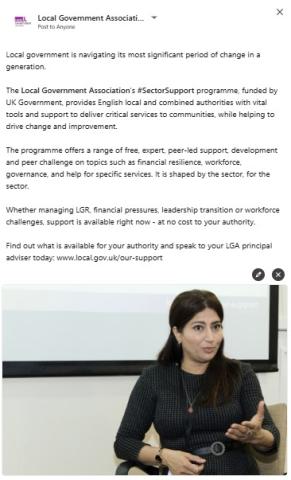
Example social media content
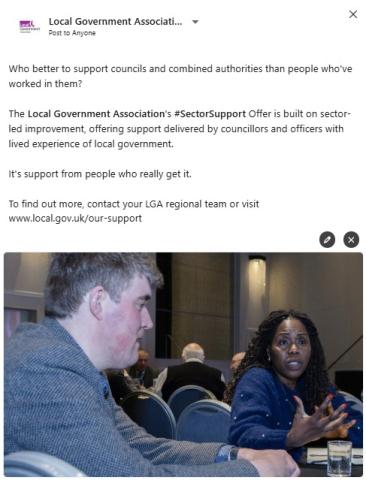
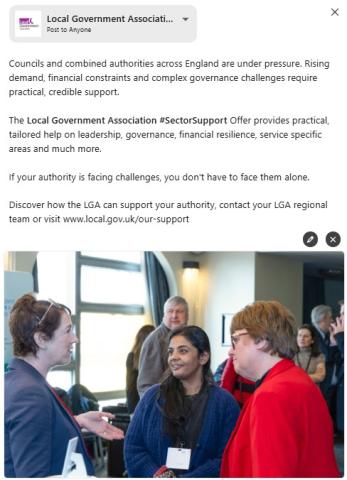
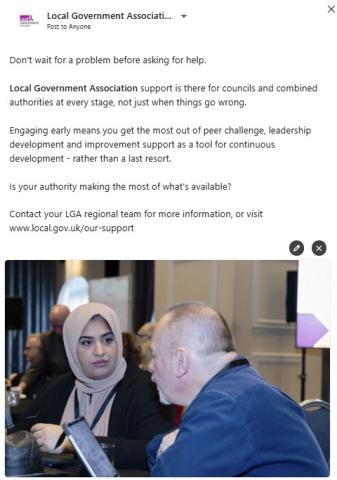
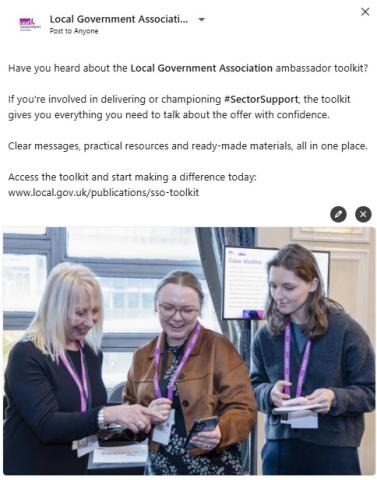
We have included below a set of ready-to-use and adaptable social media posts for LinkedIn, X, Facebook, Threads and Bluesky. Posts are provided for a range of campaigns, and will be updated throughout the year to include the launch of the Sector Support Offer and publication of the annual report on Sector Support, and promotion of specific programmes.
You are encouraged to adapt these posts in your own voice, adding personal commentary or examples from your own experience where relevant. A few principles to bear in mind when adapting content:
- Keep the core message accurate and consistent with your experience and the narrative in this document.
- Add your own perspective or experience to make the post feel authentic.
- Link to the relevant LGA webpage where possible.
- Use accessible formatting, including standard hashtags (for example, #SectorSupport rather than #sectorsupport).
Social media assets
Please see below for assets you can use in social media posts or other communications. Assets include visual, written, and digital resources that can be used to communicate and build presence.
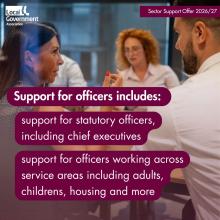
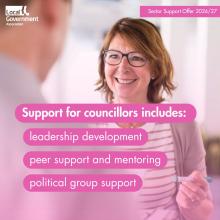
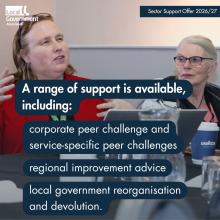
The following videos have been developed, which you may find useful to use in social media posts:
| Video: Sector Support for officers | Video: Sector Support for councillors | Video: Whole council Sector Support |
|---|---|---|
|
|
|
Sector Support Offer: Quick reference guide
This short, accessible summary of what the Sector Support Offer is and how to access it is designed to be shared with colleagues who may be unfamiliar with the offer or would like a clear overview before a conversation or meeting. It sets out the breadth of support available, from peer challenge and regional support through to service specific and specialist and technical offers.
The FAQs also provide a resource to draw on.
Peer support explained
A short guide setting out how the LGA’s peer support model works, why it is valued across the sector, and how councillors, officers and councils can access confidential, practical support from experienced peers, with testimonials.
An introduction to the peer challenge process and the role of peers.
LGA explained slide deck
A concise presentation pack designed for meetings, conferences and briefings, helping members and officers explain the LGA and Sector Support Offer clearly and consistently.
Further tools and resources
- Sector Support Offer
- LGR and Devolution Hub
- Sector Support Annual Report 2024/25
- Corporate Peer Challenge Annual Report 2025/26
- Innovation Zone 2025 showcase publication.
We have also developed a peer ambassador communications toolkit, offering specific guidance for peers promoting peer challenges.
Key contacts
The first point of contact for councils or combined authorities wishing to access support is usually the relevant regional team, who are available to discuss local priorities, explain support available and advise on the most relevant programmes or services for each authority.
LGA principal advisers and regional teams offer a first point of contact, offering unique insight at the regional level.
Members may also wish to contact their Political Group Office where support relates to political leadership, opposition roles, group development or sensitive local issues.
Political Group Offices can help connect councillors with experienced peers from their own party who understand the realities of local leadership and local politics first-hand. Support is confidential, practical and tailored to the circumstances you are facing.
If you have questions about how to communicate about the offer effectively, need additional information or want to share feedback about the toolkit, please contact [email protected].
Providing feedback on this toolkit
Your experience as an ambassador is valuable in helping to improve this toolkit and the campaign more broadly. If you have suggestions for how this toolkit could be strengthened, or if you have insights from your conversations and advocacy activity that you would like to share, please get in touch with the [email protected].
Feedback on what is working well, what questions you are encountering and what additional resources would be helpful is particularly welcome.